Code, not transfers: what Ethereum state shows about the $6.3B Binance hack
Binance 14 had no code for 5½ years, then ran a foreign EIP-7702 delegate for 3h49m. What Ethereum state shows that a transfer list can't.
The fund flow has been covered. This is the Ethereum-only part a transfer list can’t show: a 5½-year-old hot wallet that ran foreign code for 3h49m, what that code does, how it was rehearsed, and how the freezes actually executed on chain.
TL;DR
- Binance 14 (0x28C6…1d60) had no code from April 2021 through 18.9M sent transactions. At 20:20:59 UTC on 29 Oct it got code for the first time: the 23-byte delegation designator 0xef0100 ‖ 0x63e8…6fAe. It lost it at 00:10:35. That 3h49m interval is the attack.
- The takeover emitted no logs and wrote no storage. It is visible only as an authorization list in the transaction body, a nonce bump, and a code change.
- 50 signatures, ordered by descending nonce, so at most one could apply. The gas receipt shows exactly one did.
- The delegate’s behaviour is consistent with keeping the wallet operational: it leaves exactly 1 ETH, accepts plain ETH, never touches storage, and skips tokens that fail instead of reverting.
- The delegate was rewritten between rehearsal and attack. v2 = v1 + one generic pass-through to a smart account’s execute(), then used on Binance’s. The rehearsal delegations are still live on chain.
- 204.3M USDT was swept into the collector after Tether had already listed it: a USDT listing stops spending, not receiving.
- Freezes, from their own events: 9 Tether listings, Circle listings including a Uniswap V2 pool, and Aave freezing 32 reserves. Aave’s freeze blocks new supply and borrowing; it does not lock existing positions.
EIP-7702 in three sentences
Since Ethereum’s Pectra upgrade, an ordinary wallet (EOA) can sign an “authorization” that makes it run a smart contract’s code as its own. Anyone holding that signature can submit it in a type-4 transaction; from then on, every call to the wallet executes the delegate’s code, until the wallet signs a new authorization pointing elsewhere or to address 0. Whoever wrote the delegate decides what calls the wallet will obey.
5½ years without code
TraceFast’s attribute history for Binance 14 is short:
- block 12,288,433 (April 2021) → 26,300,753: plain EOA, no code
- 26,300,753 → 26,301,896: EIP-7702 delegated
- from 26,301,896: no code again
Over 18.9 million sent transactions, this address never had code. Then, for 1,143 blocks, it had 23 bytes: 0xef0100 followed by the address of a contract deployed 4h22m earlier.
For a hot wallet with that history, “code is no longer empty” is as clean an alert as exists. Nothing else about the takeover is as visible:
- the delegation transaction: 0 logs, 0 storage writes, 0 internal transfers;
- the revocation transaction: 0 logs, 0 storage writes;
- a call tracer shows only a 62-gas call into the wallet.
What does exist: the authorization tuples in the transaction body, the nonce bump, and the code change in the block’s state diff. TraceFast’s block participants list Binance 14 in block 26,300,753 with codeChanged = true.
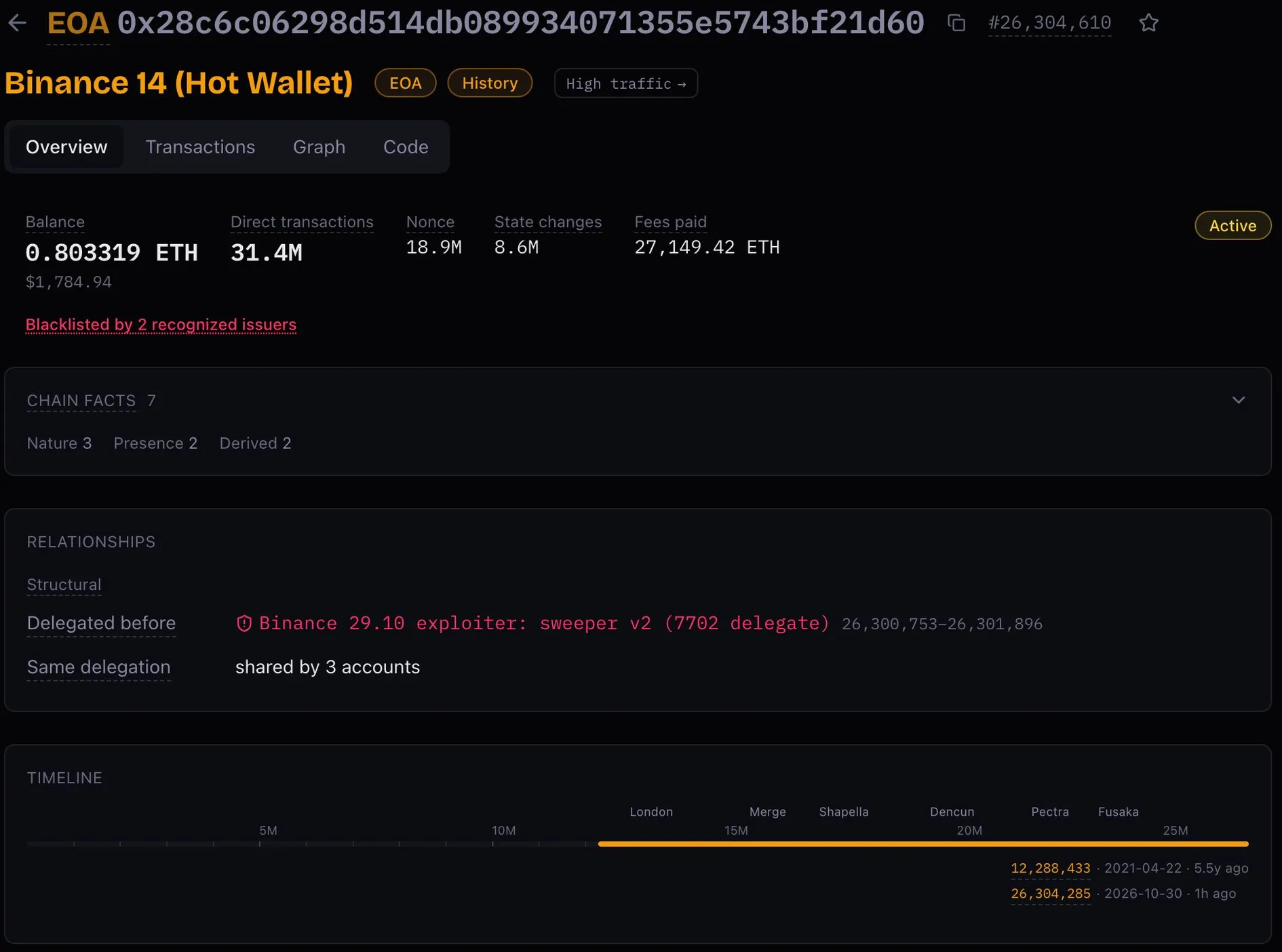
Binance 14 on TraceFast: first seen at block 12,288,433 (2021-04-22); one delegation, to 0x63e8…6fae, blocks 26,300,753–26,301,896.
One code change out of 50 signatures
The operator 0x7C86…5CA0 sent one type-4 transaction carrying 50 authorizations, every one recovering to Binance 14 and pointing at 0x63e8…6fAe, all for chain ID 1.
An authorization only applies if it carries the authority’s nonce at execution time. Binance 14’s nonce moves every block (about 2–3 transactions per block), so no single signature could target the inclusion nonce; the signed set covers a 50-nonce window, 18,914,775 to 18,914,824. The lowest signed nonce had already been used 15 blocks before inclusion — consistent with signatures produced minutes in advance. Binance’s own transaction with nonce 18,914,808 landed five positions earlier in the same block; entry #15 (nonce 18,914,809) applied. Binance’s next transaction used 18,914,810.
The list is ordered from high nonce to low. Tuples are processed in order and an applied tuple increments the nonce, so nothing after the match can match: exactly one Binance nonce was consumed. For defenders, that means nonce-gap monitoring would not have fired. (Why the operator ordered it this way is our inference; the processing rule is protocol fact.)
The gas receipt shows exactly one application: 21,000 + 50 × 25,000 − 12,500 (refunded only for an applied tuple whose account already exists) + 62 = 1,258,562.
The same check works for the revocation: 46,000 intrinsic − 9,200 (the 12,500 refund, capped at one fifth of gas used by EIP-3529) = 36,800, its receipt value. Binance 14 sent it itself, so its authorization had to carry the next nonce: transaction nonce 18,914,903, authorization nonce 18,914,904.
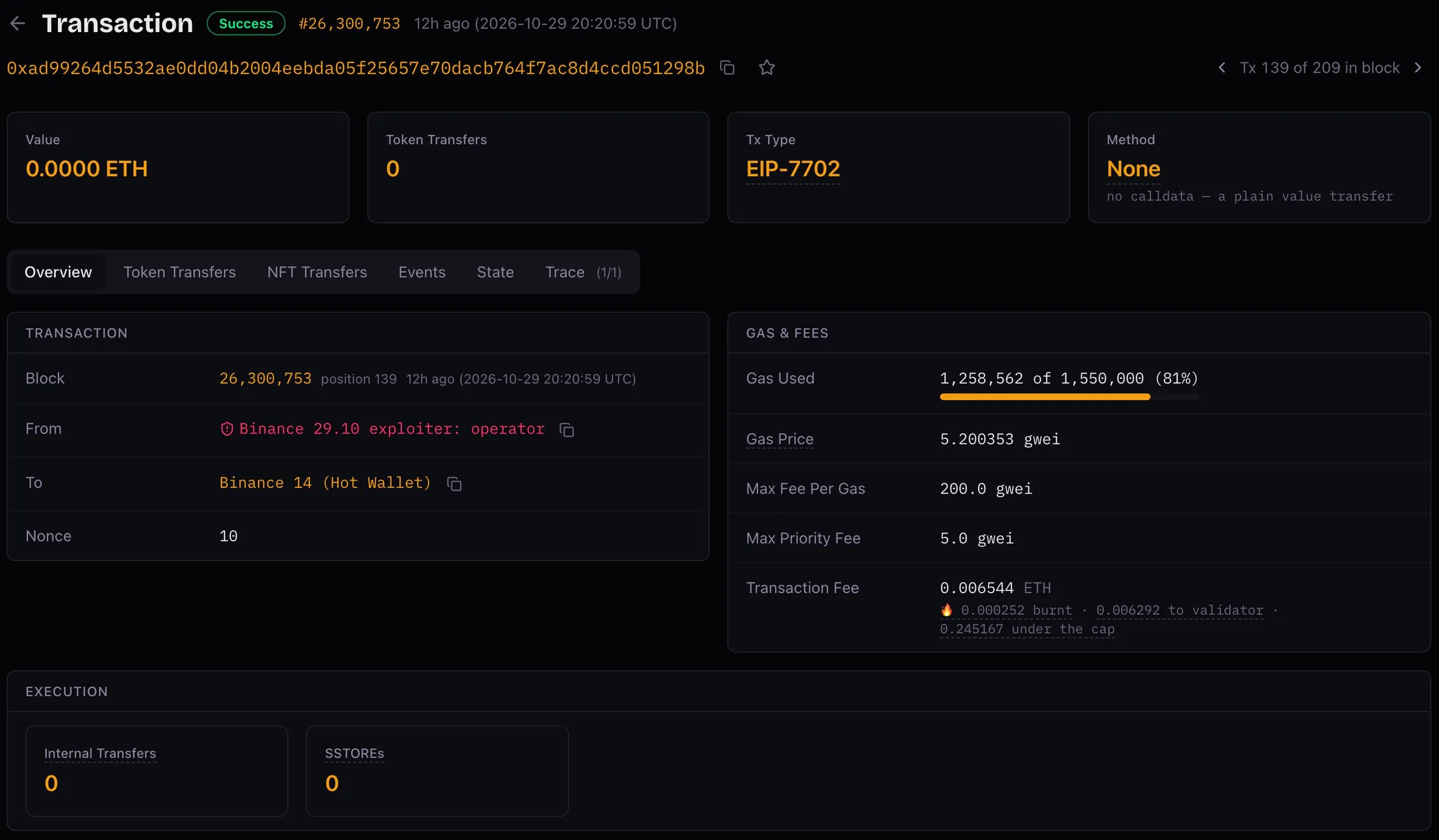
The delegation transaction: EIP-7702, no calldata, gas used 1,258,562, 0 internal transfers, 0 SSTOREs.
What 1,674 bytes do
The delegate keeps no state. The operator’s address is a PUSH20 constant compared with CALLER on every state-changing function; the bytecode has no SLOAD, SSTORE, DELEGATECALL, CREATE or SELFDESTRUCT. Revocation never clears storage — here there was nothing to clear: across the 129 storage writes of the first sweep, none touched Binance 14’s storage.
The 62 gas in the delegation transaction is itself evidence: it is exactly the delegate’s empty-calldata path. An account without code would have used 0. The code was live inside the same transaction that installed it.
What the code does, and what that implies (the implications are our reading, not a stated intent):
- ETH, when requested: if the balance is above 1 ETH, send balance − 1 ETH. After the first sweep Binance 14 held exactly 1.000000000000000000 ETH — enough gas for its own pipeline. It sent 93 more transactions of its own while delegated.
- Empty calldata hits STOP, as an empty receive() does: the wallet keeps accepting plain ETH, so inflows kept arriving and stayed reachable.
- Tokens: balanceOf → transfer(all) per token; if a transfer reverts, emit an event and move on (return values are not checked). In the first sweep KITE reverted with EnforcedPause(); 60+ other tokens still moved.
- The recipient is an argument, not a constant — later sweeps went to a second collector without redeploying.
A side effect of any 7702 delegation: while the code was in place, any call to Binance 14 that carried calldata would have run the delegate’s dispatcher, and unknown selectors would have reverted.
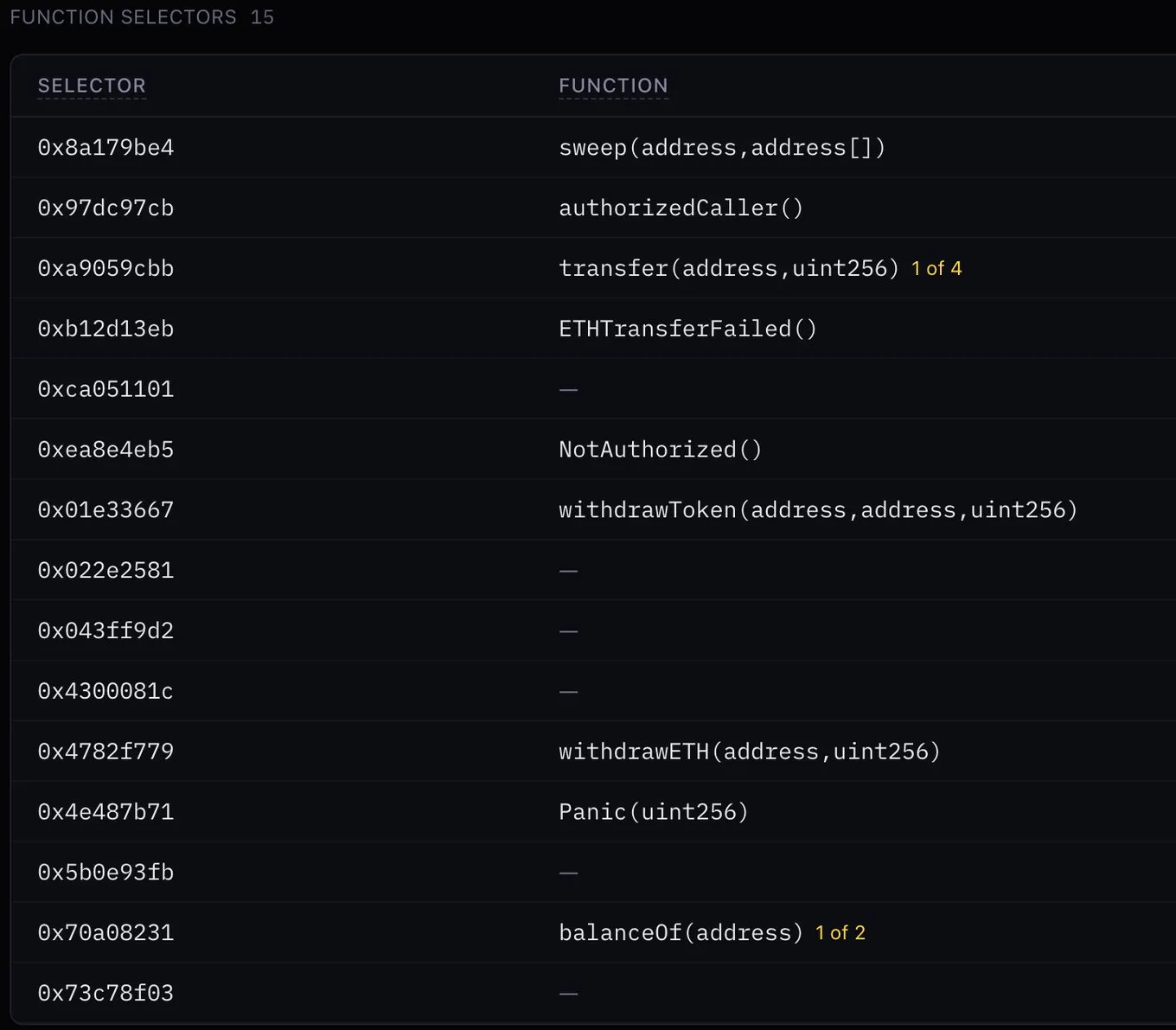
The delegate: 5 external functions — sweep, withdrawETH, withdrawToken, authorizedCaller and 0x043ff9d2, the v2 addition. The other 4-byte constants are outbound calls, errors and compiler metadata; 0x5b0e93fb is execute() (0xb61d27f6) stored shifted right by one bit.
The rewrite between rehearsal and attack
The operator deployed two delegates and rehearsed both on fresh wallets of its own:
- 02:28:59 — v1 deployed (0x19be…f2bf, 1,256 bytes).
- 13:51:35 / 13:51:59 — v1 installed on 0x8378…fbc3 and 0x9c29…dbb6; test sweeps at 14:19 and 14:24.
- 15:59:11 — v2 deployed (0x63e8…6fAe, 1,674 bytes).
- 16:20:47 — v2 installed on 0x43ae…04bd; sweep at 16:30, withdrawETH back to the funding wallet at 16:47.
- 20:20:59 — v2 installed on Binance 14.
The bytecode diff between v1 and v2 is one function, 0x043ff9d2 (account, target, value, data): check that the account has code, then call account.execute(target, value, data). It is generic — any smart account with an execute() would do. Binance 14 is the executor of a smart account (0xee7A…4055). At 20:41:23 and 20:59:47 the operator used exactly this function, and the smart account transferred 780M and 43M USDC out (the 823M TRM reports).
None of the three rehearsal delegations was ever revoked. 0x8378 and 0x9c29 still point at v1; 0x43ae still points at v2. The delegate sat on chain, rehearsed, for 4h22m before it reached Binance — a contract with sweep(address,address[]), a hardcoded caller and no storage is a fingerprint a watchlist can carry.
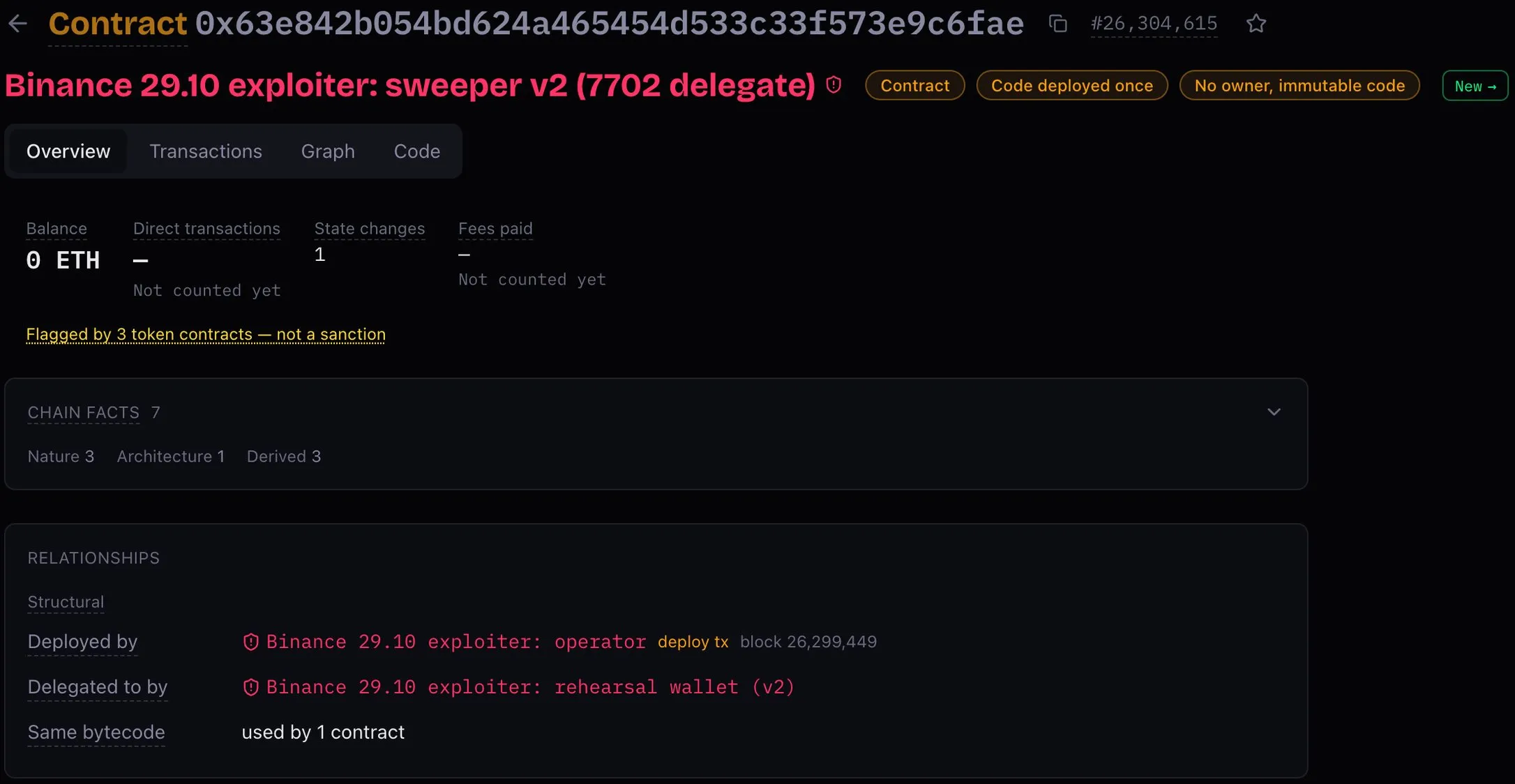
Sweeper v2: deployed by the operator at block 26,299,449, immutable, unique bytecode — and still delegated to by rehearsal wallet 0x43ae…04bd.
3h49m with foreign code
What happened on Binance 14 while the code was in place (12 operator transactions in total):
- 20:24:23 — first sweep: 167,464 ETH, 1.62B USDT and dozens of tokens; 1 ETH left.
- 20:41:23, 20:59:47 — the two smart-account pulls (823M USDC).
- 21:04:23, 21:44:11 — follow-up sweeps: 1,700 ETH + 3.9M USDT, then 370 ETH + 200.4M USDT.
- 22:06:23 — Tether lists Binance 14 itself; Circle follows at 23:53:35.
- 22:39:35 — re-sweep to a second collector, 0xa97b…8d10: 128 ETH and 122 tokens. Its USDT leg reverts, because the source wallet is now listed — listing the source stopped this leg.
- 22:55–23:08 — Binance 14 sends 44 token transfers of its own to Binance 8 (0xF977…aceC), one more at 00:07:11.
- 23:36:47–23:38:23 — four low-gas operator sweeps in under two minutes, one more at 23:54:59: nothing to take.
- 23:55:47 — 0xeae7…a4f4 sends 2,961.99 ETH to Binance 14. On chain it looks like an exchange deposit address: inflows from payment processors and other exchanges’ wallets, and the vast majority of its 256,656 outgoing transactions since 2023 went to Binance 14; this ETH had arrived there between 18:33 and 20:42.
- 23:56:47 — swept, 60 seconds later, to 0xa97b.
- 00:10:35 — revocation; code empty again.
The chain does not say why events were sequenced this way, and we don’t know Binance’s internal constraints on revoking. The general lesson is about automation: anything that lands at an address while foreign code is installed is reachable by that code.
Issuer freezes, event by event
Freezes are on-chain transactions too. Here is what the issuers executed on Ethereum, from their own events.
Tether (USDT). In the incident window the USDT contract emitted nine AddedBlackList events, each in one transaction through Tether’s multisig (0xc6cd…a828: confirmation, the listing, then execution). At storage level a listing is one slot in USDT’s isBlackListed mapping flipping from 0 to 1.
- 21:01:35 — collector 0x5227 and route-A hop 0x9749 (same block)
- 21:01:47 — 0x0ddf; 21:02:47 — 0x8d53 (the Aave borrower)
- 21:12:35 — 0x7aa4; 21:14:59 — 0xaa24 (175M stays); 21:16:47 — 0xccbe; 21:18:59 — 0xb171 (30M stays)
- 22:06:23 — Binance 14 itself
No USDT listing for hops 0x811f or 0x77ed appears in our index; both forwarded their USDT within minutes of receiving it.
The multisig is visible step by step. Each listing takes three signatures on Tether’s wallet: one owner submits, two confirm, and the last confirmation executes it. The first freeze activity on chain is at 20:57:23–20:57:35: six confirmTransaction calls from the two confirming owners, all reverted with no message, before any submission existed. The submissions landed at 20:59:11–20:59:35, the confirmations were re-sent at 21:00:47, and the first two listings executed at 21:01:35. (Why the early confirmations reverted is our reading of the wallet’s rules; the reverts and their times are on chain.)
By then the collector’s USDT was no longer moving: 500M left 0x5227 at 20:30:11 and 200M at 20:33:23, and the remaining 1.175B sat until the listing. Of the eight attacker addresses Tether listed, five held zero USDT at their listing block — 0x9749, 0x0ddf, 0x8d53, 0x7aa4 and 0xccbe had already forwarded it.
A USDT listing blocks spending, not receiving: USDT’s transfer checks only the sender. So the operator’s sweeps kept depositing into the listed collector — 3.92M USDT at 21:04:23 and 200.4M USDT at 21:44:11, both after 0x5227’s listing at 21:01:35. Of the 1.82B USDT swept from Binance 14, 204.3M was delivered by the attacker’s own sweeps straight into a frozen address.
Circle (USDC). USDC checks both sender and recipient, so a listed address can’t receive at all — which changes the shape:
- 21:04:59 — collector 0x5227, holding the 823M pulled through the smart account.
- 23:53:35 — Binance 14; 23:54:59 — Binance’s smart account 0xee7A…4055, the contract the delegated wallet had driven.
- 04:11:35 — collector #2 0xa97b.
- 04:19:23 — the Uniswap V2 RAD/USDC pool (0x8c1c…e58c), where 0xa97b had been selling RAD. Listing a pool freezes its USDC side for everyone in it, not just for one seller.
Circle also listed 0xc39e…9824 at 23:31:59, 4 min 24 s after it received a 1,563,812.78 USDC CCTP mint at 23:27:35; we cannot link that address to this incident from Ethereum data. The other Circle listings in the window are unrelated in our data.
Token teams with admin powers went further than listing. BEAM’s Safe burned the 984.25M BEAM sitting at the collector at 21:21:59; a Safe transaction for SAND moved 58.4M SAND out of the collector at 23:27:11 — in both cases without the collector signing anything. The 48.5M WLFI swept at 20:24 is still at 0x5227 on Ethereum; we see no WLFI freeze event in our index.
A stablecoin listing freezes that stablecoin, not the address. After its USDT and USDC listings, 0x5227 kept moving everything else: 7.02M UNI at 21:46:59, 7.77T PEPE at 21:49:11, 217.5M ENA at 22:02:11 and 2.57M LINK at 22:34:59, each to a separate address for selling. It also sold long-tail tokens itself, straight into DEX pools — CFG, IMX, CVX, RAD, RED and OGN among them. TraceFast’s ledger for the collector shows about 15.9k ETH coming back from Uniswap and PancakeSwap routers (14,902 + 764 + 258 ETH; verified counterparties only). At 05:15 the collector sent 17,260 ETH to the fresh address 0x03b0, where it still sits.
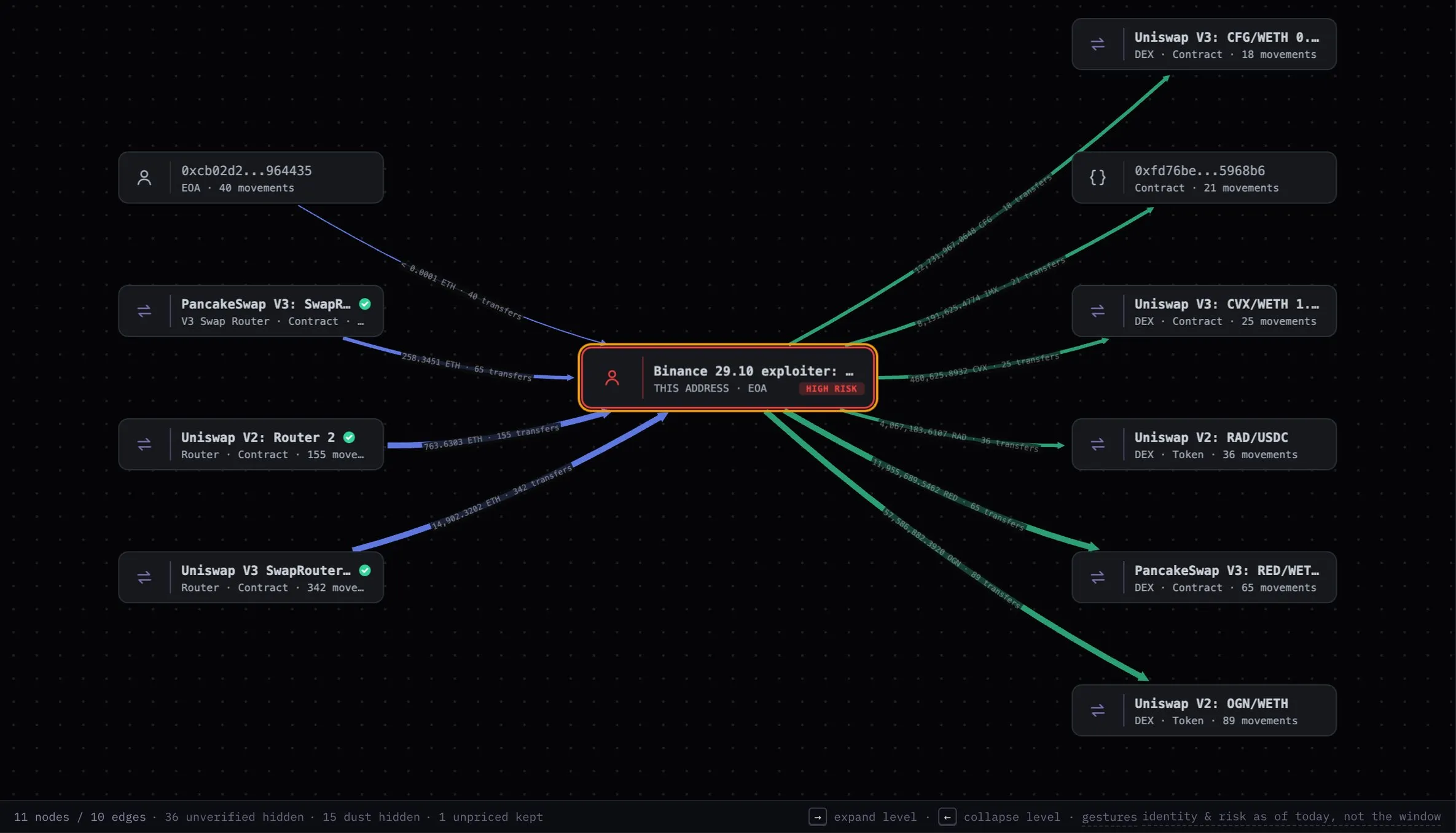
Collector #1 on TraceFast’s ledger graph: tokens out to DEX pools (green), ETH back from routers (blue). Verified counterparties only; 36 unverified and 15 dust counterparties hidden.
Coinbase (cbETH, cbBTC), Binance (wBETH) and several smaller issuers also listed attacker addresses that held none of their tokens at the time, per our index — preventive listings rather than freezes.
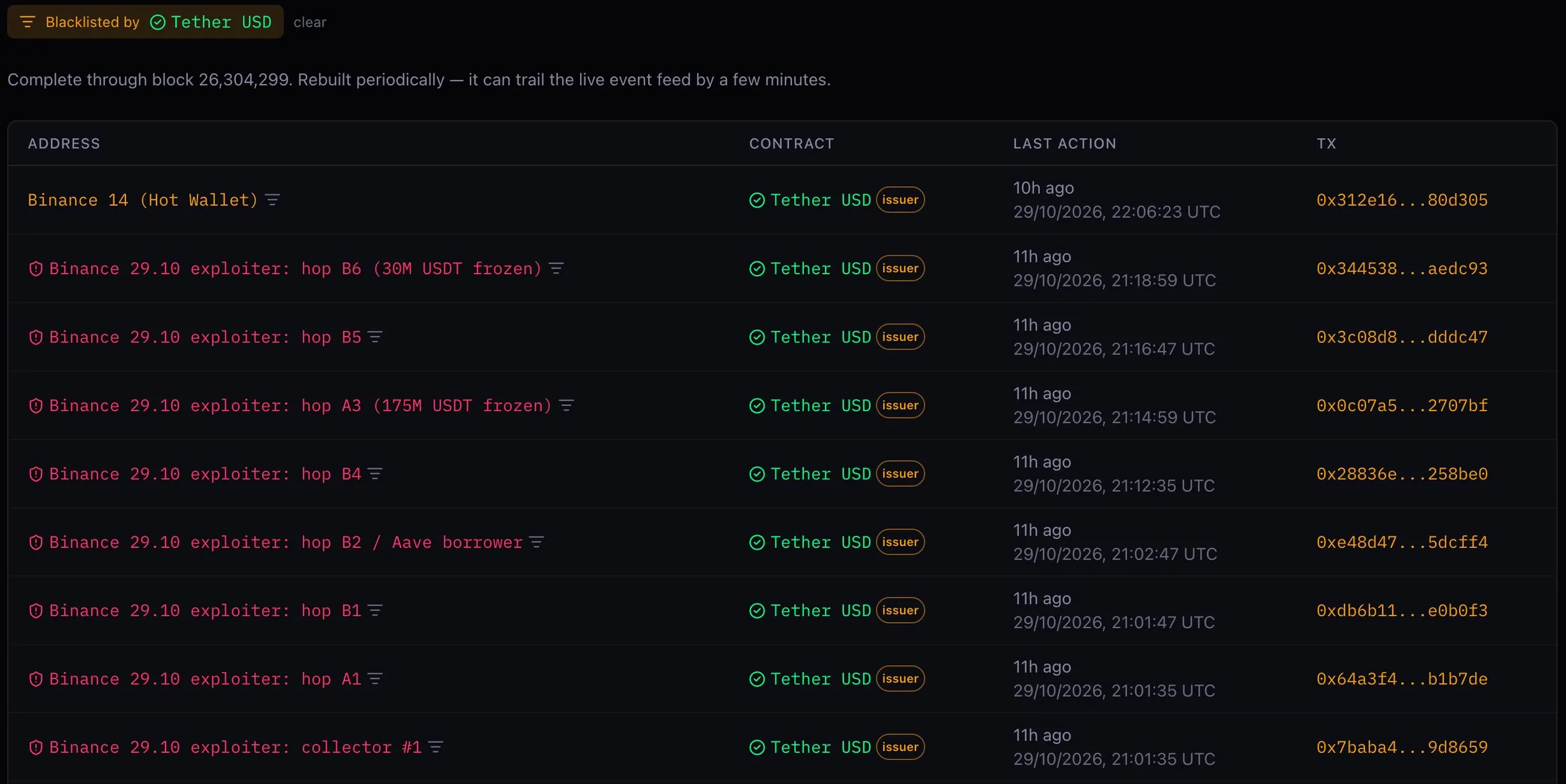
Addresses blacklisted by Tether USD on TraceFast: the nine incident listings, 21:01:35–22:06:23 UTC.
Aave: freezing a market, not a user
Aave cannot blacklist a user. What it did was change market parameters: three transactions from its emergency multisig (0x2cfe…aa30) on the Ethereum Core PoolConfigurator.
- 21:47:23 — 11 reserves, USDT first, then USDC, WETH, WBTC, AAVE, LINK, RLUSD, XAUt, USDe…
- 21:48:59 — 11 more (wstETH, DAI, cbETH, rETH, sUSDe, cbBTC…); 21:49:59 — 10 more. 32 reserves in 2 min 36 s.
Every reserve got ReserveFrozen: no new supply, no new borrowing. The 15 reserves that still had a loan-to-value above zero had it set to 0, with the old value kept as a pending LTV for the unfreeze (USDT: 75% → 0, liquidation threshold left at 78%); LTVs in efficiency-mode categories were zeroed too.
This was a market-wide risk measure; the attacker’s borrows had completed at 21:00:59. A freeze does not lock existing positions: Aave’s documentation is explicit that repayments, withdrawals and liquidations stay open on a frozen reserve. Only a pause stops withdrawals, and it stops them for every user.
The attacker’s position, at state as of ~08:15 UTC 30 Oct:
- 0x8d53 holds 60,003,659 aEthUSDT against 19,762.84 WETH of variable debt (growing with interest); no transaction since 21:02:35.
- Tether’s listing applies to USDT held by 0x8d53, not to its claim inside Aave.
- At a 78% liquidation threshold and ETH ≈ $2,228, the health factor is ≈1.06; the position becomes liquidatable near ETH ≈ $2,368, a level that drifts lower as interest accrues. A liquidation would repay part of the debt and pay the matching USDT collateral plus a 4.5% bonus to the liquidator.
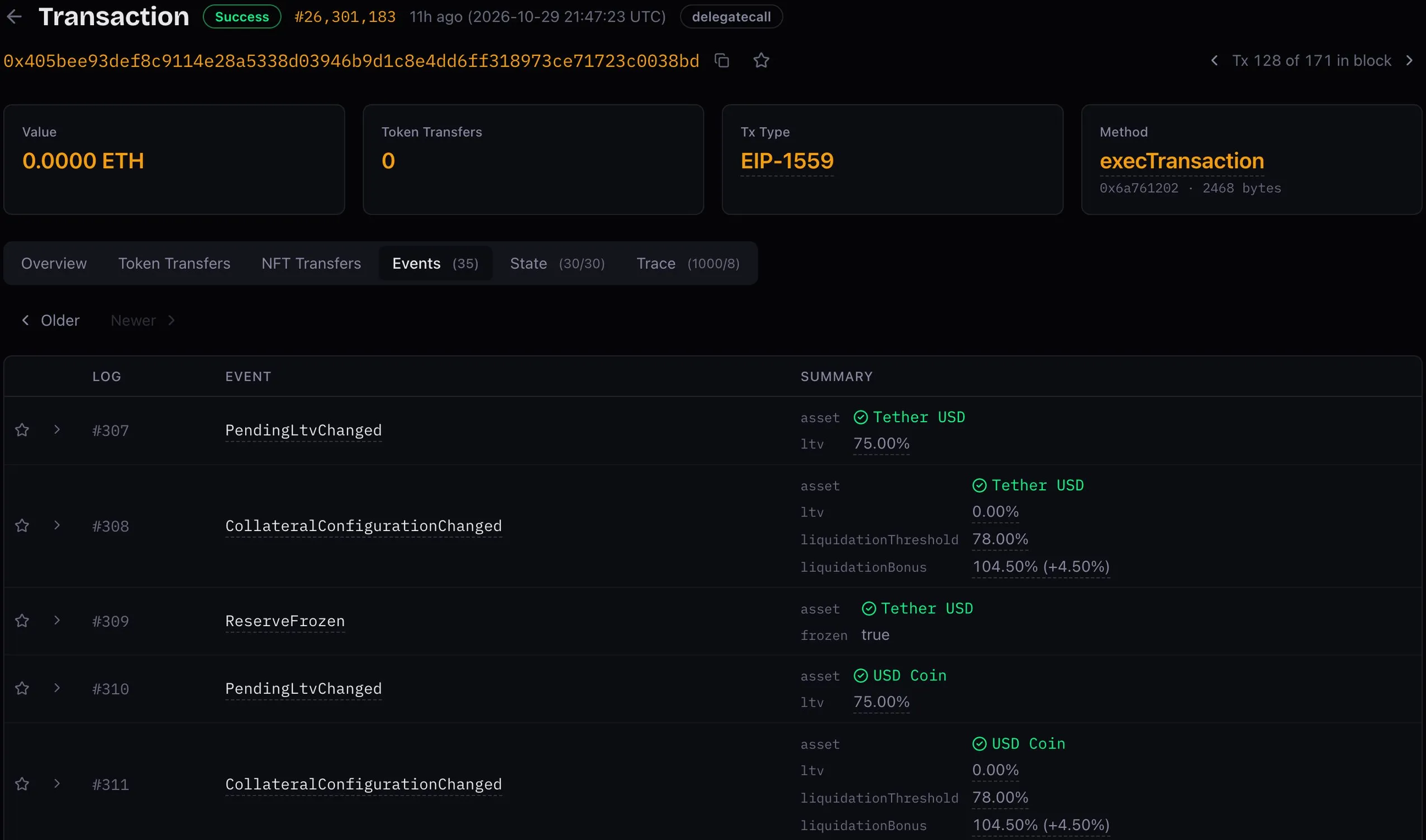
The first of Aave’s three freeze transactions (21:47:23 UTC), via its emergency multisig: per reserve, PendingLtvChanged → CollateralConfigurationChanged (LTV 0) → ReserveFrozen. USDT first, then USDC.
The attacker changes code too
EIP-7702 shows up on the other side as well. The USDT hop wallets 0x77ed…c3eb and 0x7aa4…bfd1 each made their first-ever transaction a self-sponsored type-4:
- 0x77ed received 130M USDT at 21:01:59. At 21:04:47, nonce 0: delegate itself to MetaMask’s EIP7702StatelessDeleGator (0x63c0…e32b — a public, widely used implementation; no suggestion of involvement) and, in the same transaction, execute() a batch — USDT.approve(Permit2) → Permit2.approve(UniversalRouter) → UniversalRouter split-swap across V2/V3/V4 pools. 398 call frames, 136 logs, 67 token transfers across 41 pools, 95 gwei.
- 0x7aa4 received 80M at 21:06:47 and did the same at 21:08:23, at index 0 of its block.
The first transaction combines delegation, approvals and the first batch of swaps; later sells were plain router calls reusing those approvals. Whether fewer transactions per wallet was the aim, the chain can’t tell. 0x8d53 and 0x7aa4 forwarded USDT 48 s and 84 s before their own listings.
UniswapX fillers — market makers filling public orders, with nothing suggesting knowledge of the source — also run 7702-delegated accounts. Code on an EOA is now ordinary on both sides of a trade.
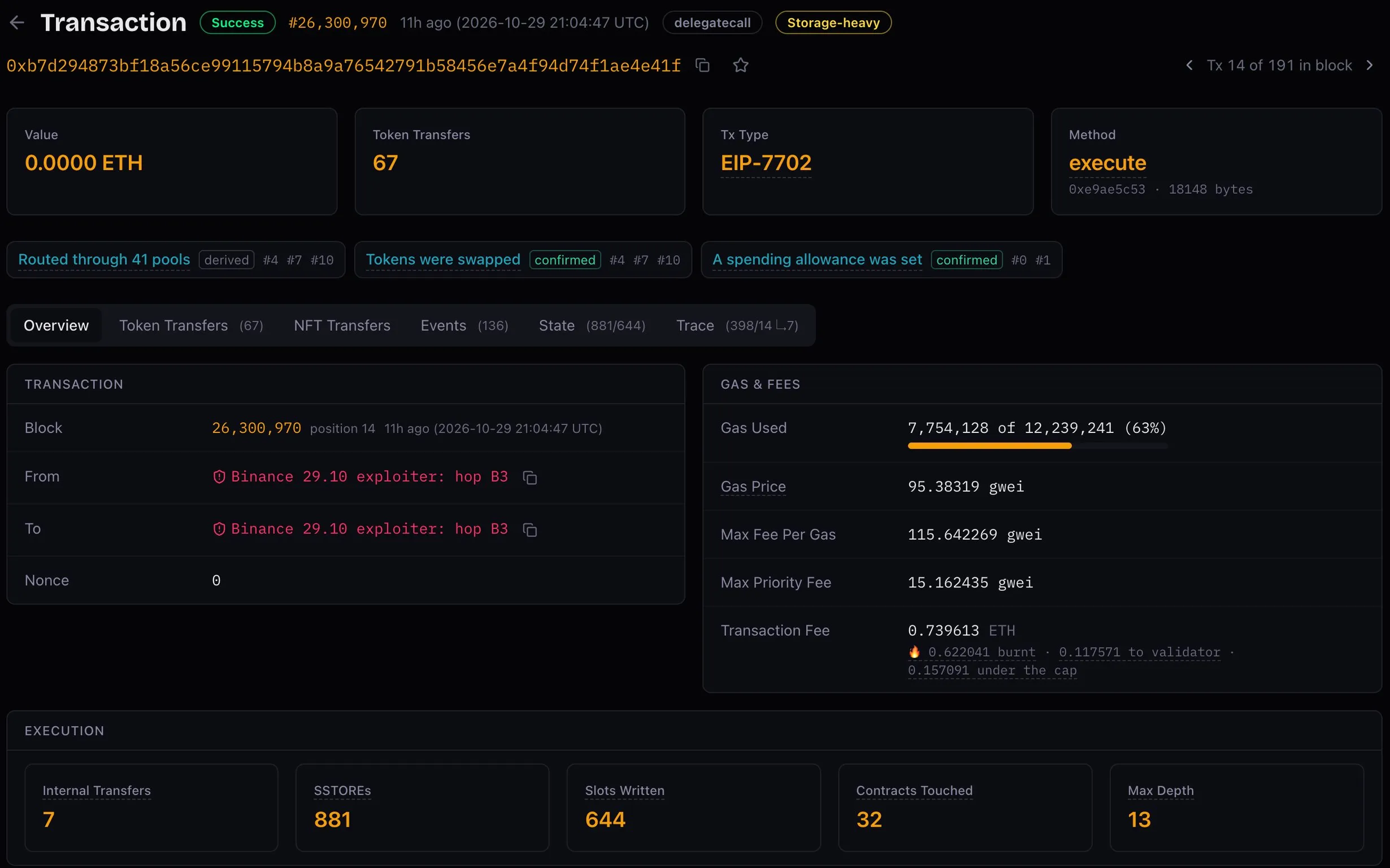
Hop wallet 0x77ed, nonce 0, sending to itself: EIP-7702 + execute(), routed through 41 pools, 67 token transfers, 95 gwei.
Detection, at state level
- Baseline your EOAs: first-ever non-empty code on a long-lived hot wallet should page someone. Here it would have fired 3m24s before the first sweep.
- Parse authorization lists, not logs — every tuple naming your address, including invalid ones and ones in reverted transactions (delegations persist even if the transaction reverts).
- Watch delegates, not just victims: a new contract with a sweep loop, a hardcoded caller and no storage, installed on fresh wallets, is a pre-attack signal.
- If a hot wallet’s code is not empty: stop automated inflows to it and revoke (authorization to address 0; if the wallet sends the revocation itself, nonce = transaction nonce + 1, otherwise its current nonce).
- After revoking, treat the signer as compromised until the wallet’s nonce is past every nonce it may have signed. Here all 50 authorizations died once the nonce passed 18,914,824.
- Whatever the root cause turns out to be, hot-wallet signers should parse what they sign: refuse 0x05-prefixed authorization payloads, chain-ID-0 authorizations and raw digests by default, and rate-limit signatures per wallet.
Short reference: where the Ethereum funds are
- Through the delegated Binance 14, the operator’s 12 transactions moved 169,534 ETH, 1.82B USDT and 823M USDC to 0x5227, and 3,090 ETH plus 122 tokens to 0xa97b (2,962 of that ETH arrived in Binance 14 after the compromise). Separately, Binance 16 (0xDFd5…963d) sent 28,005.6 ETH, 55.74M USDT and seven other tokens (RLUSD, WBTC, UNI, XAUt, ENA, LINK, PEPE) to 0x5227 at 20:24:47 — nine ordinary signed transactions in one block, interleaved with the wallet’s routine payouts, and no code change on that wallet.
- 0x5227…2f8c, collector #1: ~$2.11B, mostly listed USDT and USDC; also XAUt, USD1, PAXG (no XAUt/PAXG/USD1 listing event in our index — absence from our index is not evidence either way).
- The 700M USDT that left the collector before its listing: 175M frozen at 0xaa24, 30M at 0xb171, 60M supplied to Aave, and the remaining ≈435M swapped to ETH on routes A and B.
- Three never-spent addresses hold ~233,300 ETH: 0xc887…286A (137,602), 0x897c…8df3 (78,415), 0x03b0…20ea (17,260).
- Aave V3: 0x8d53…639a, 60.0M aEthUSDT vs 19,762.84 WETH debt.
- Full IOC list (full addresses) and a separate list of look-alike addresses created by fake-token “Transfer” spam — do not block those — at [link].
Method
Ethereum mainnet via TraceFast: authorization lists, block participants (state diffs), attribute and relation history, bytecode and selectors, call traces and frames, failures, events, storage writes, blacklist events, balances. State as of block ~26,304,300 (~08:15 UTC 30 Oct 2026); “still”, “never” and balances refer to that block. Other chains are out of scope; TRM Labs’ write-up covers the cross-chain picture and attribution. Times UTC. Labels are on-chain facts; we do not know who controls any address.