The sven.eth EIP-7702 drain: 119 wired wallets, a 15-hour run, and an operator’s wrong paste
sven.eth lost 9.12 ETH to an EIP-7702 drain. The delegate still has 119 wired wallets; the operator ran for 15 hours, then pasted the wrong address.
On October 13, 2026, at 23:43:59 UTC, the wallet behind sven.eth lost 9.12 ETH and a freshly claimed TAPEETH reward in one transaction it neither sent nor paid for. ExVul flagged it the next morning; multiple outlets reported a loss of about $22.7K.
The chain says more. Nine minutes later the operator sent its entire balance — 9.58 ETH, including 16 other victims’ funds — to sven.eth by mistake, as @sprunky_eth showed on October 14. The contract that drained sven.eth still has 119 accounts delegated to it today. And the signature that enabled the drain could not have been “weeks old,” as the coverage says: the account’s nonce puts it inside an 84-second window.
Here is the case as execution-level data records it: the transaction, the contract, the operator’s fifteen hours, and what each of them means for anyone who has to find the next wired wallet.
Two generations of 7702 abuse
EIP-7702 went live with Pectra in May 2025. It lets an ordinary account (an EOA) point to contract code. The account keeps its address and its balance, but calls to it now execute the delegated code in the account’s own context.
The first wave was crude. Within weeks, Wintermute found over 97% of all delegations pointing at copies of one short sweeper, nicknamed CrimeEnjoyor, wired to accounts whose private keys had already leaked. About 2.88 ETH of gas authorized roughly 79,000 addresses; one contract handled more than 52,000 of them. Mass production, barely profitable, because those wallets were already empty.
The second wave needs no leaked key. The victim signs an authorization on a phishing page. The attacker wraps it into a type-4 transaction, pays the gas, and runs a batch of calls inside the victim’s account. Scam Sniffer logged two such cases above $1M in August 2025. The sven.eth case is this pattern, and a cleaner specimen than most, because the operator left everything else on-chain too.
The transaction, frame by frame
Transaction 0x36e0d1…e820ee, block 26,186,935, index 2.
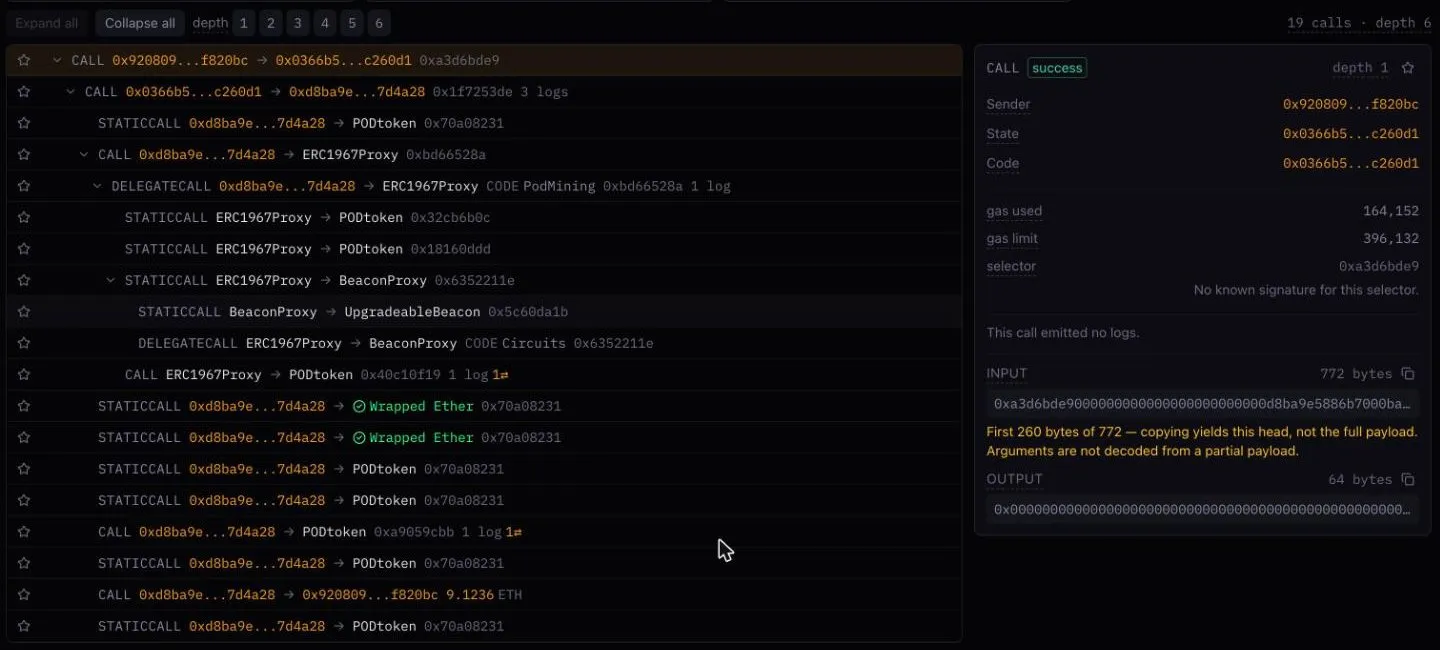
The full call tree: 19 frames, all successful. Source: TraceFast.
• Sender and gas payer: 0x9208…820bc. Fee ~0.00056 ETH, about $1.30.
• Type 4. One authorization: authority sven.eth (0xd8ba…4A28), delegate 0x0366…260D1, nonce 7442. The block carried four authorizations in total; only this one points at 0x0366.
• Destination: the same contract, 0x0366…260D1. Method run(address target, bytes data), selector 0xa3d6bde9.
The address the attacker calls and the code installed into the victim’s account are the same contract. In one transaction it plays two roles: the entry point the attacker talks to, and the code the victim’s account now runs. run() calls the target, sven.eth, with an inner selector (0x1f7253de) and a list of what to sweep. Because sven.eth now carries the delegation, that inner call executes inside the victim’s account, with the victim’s balance and the victim’s permissions.
Nineteen frames, all successful. Inside the victim’s context:
1. TAPEETH.balanceOf(attacker) → 0. A baseline, before anything moves.
2. PodMining.claim (0xaa85…5d13, a proxy): the implementation checks the owner of pod NFT #2 (sven.eth) and mints 1.69271471 TAPEETH to sven.eth. Events: Transfer(0x0 → sven.eth), Claimed.
3. WETH.balanceOf(sven.eth) → 0, checked twice. Nothing to take; the step is skipped.
4. TAPEETH.balanceOf(sven.eth) → 1.69271471; TAPEETH.balanceOf(attacker) → 0.
5. TAPEETH.transfer(attacker, 1.69271471) → true. Then TAPEETH.balanceOf(attacker) → 1.69271471. Verified.
6. A plain value call: 9.123657838802131494 ETH from sven.eth to 0x9208…820bc.
7. TAPEETH.balanceOf(attacker), once more.
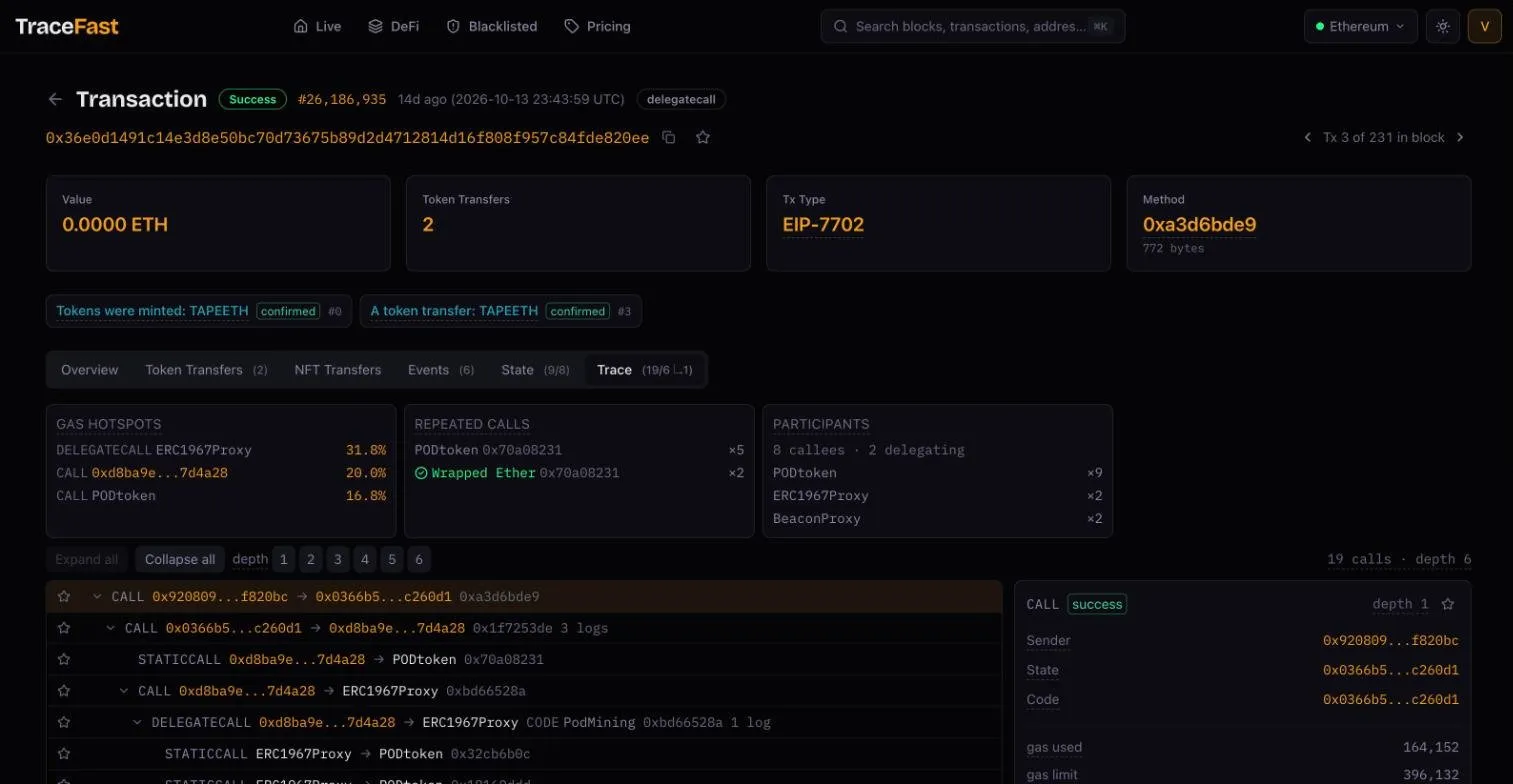
Gas hotspots, repeated calls, participants: 8 callees, 2 delegating.
The code reports on itself. It emits CallResult(i=0, ok=true) after the claim, and two events the platform decodes as Swept, emitted from the victim’s own address: one naming the TAPEETH contract and the amount, one naming address zero and 9.1237 ETH. “Swept token” and “swept native.” A drainer with telemetry, and a balance check before and after every move: this batch does not fail quietly, it confirms.
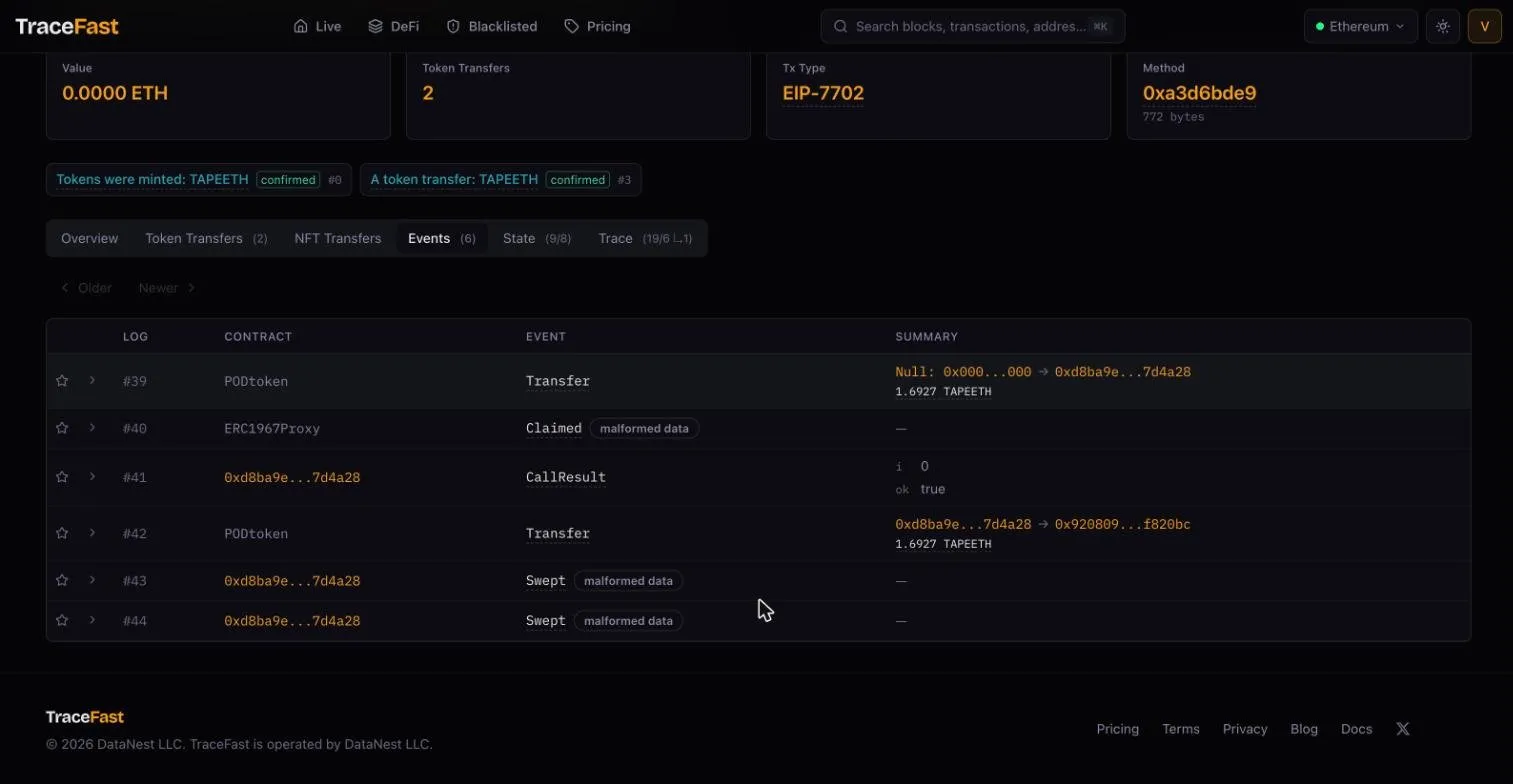
The six logs: mint, Claimed, CallResult ok=true, transfer to the operator, Swept ×2.
Not weeks. Eighty-four seconds.
Coverage of this case says the victim signed the authorization days or weeks before. For this account, the nonce rules that out.
An EIP-7702 authorization is valid only if the signed nonce equals the account’s nonce at execution. sven.eth is an active account: more than 9,000 transactions since April 2026, dozens a day. Its own transaction with nonce 7441, a router call after two approve() calls, landed in block 26,186,928 at 23:42:35 UTC. From that moment its nonce was 7442. The drain, carrying an authorization with nonce 7442, landed at 23:43:59.
So either the signature was produced inside that 84-second window, with the victim on the phishing page right then, after three transactions of what looks like an ordinary session, or the phishing flow collected signatures for several future nonces at once. Both are worth knowing. Neither is “weeks.”
The operator’s fifteen hours
The address 0x9208…820bc did not exist before 23:22:23 UTC on October 13.
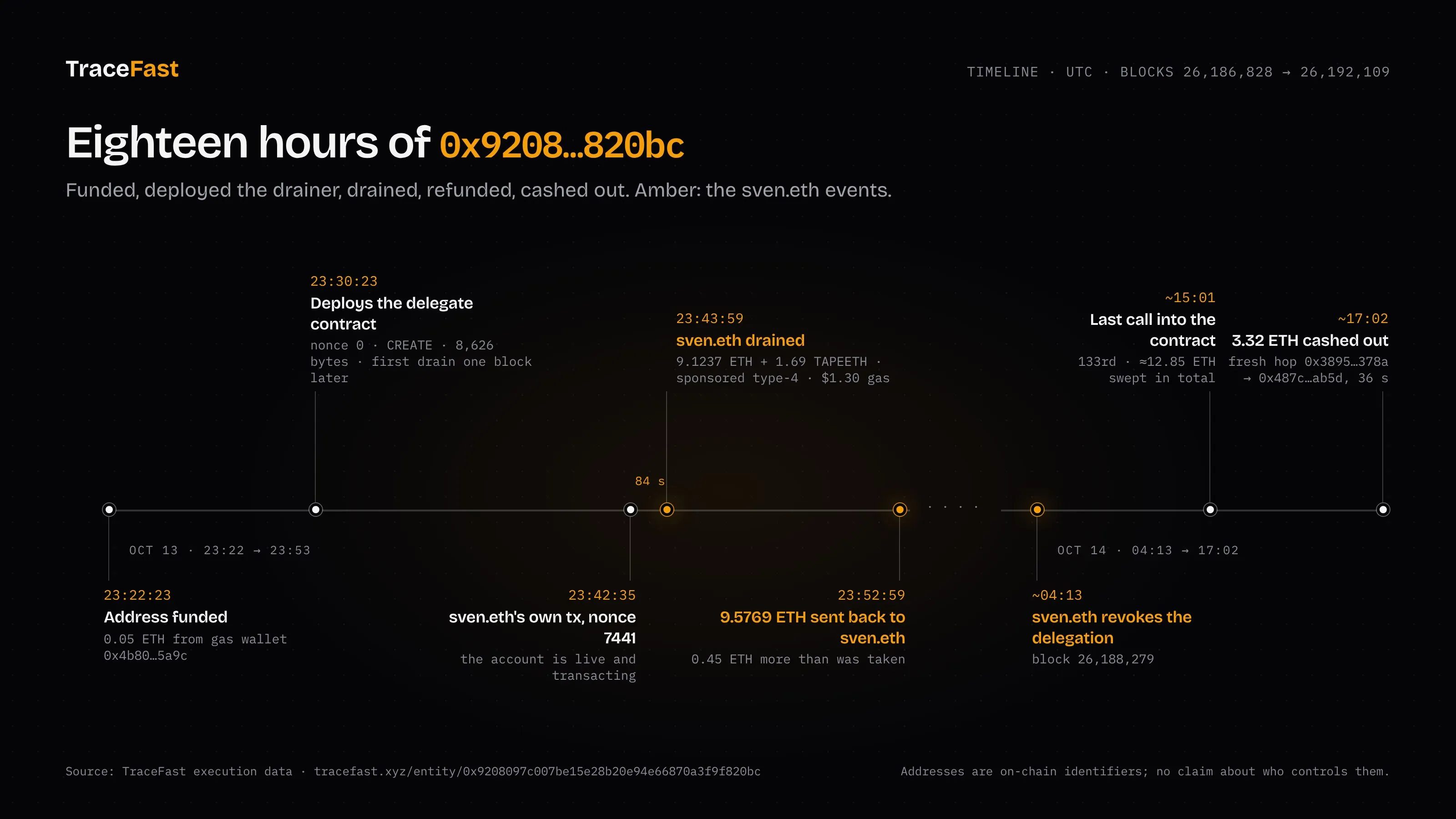
Eighteen hours of the operator address, UTC. Amber: the sven.eth events.
• 23:22:23 (block 26,186,828): funded with 0.05 ETH by 0x4b80…5a9c.
• 23:30:23 (block 26,186,868): deploys 0x0366…260D1 with its first transaction, nonce 0, CREATE, 8,626 bytes of code.
• Block 26,186,869, one block later: the first run() and the first delegation to the new contract. A CREATE address is deterministic (deployer plus nonce), so authorizations naming 0x0366 could be collected before the contract existed.
• 23:43:59: sven.eth. Then one drain roughly every block until 23:52: seventeen run() calls in eight minutes.
• Next ~15 hours: 133 transactions into the contract in total, drains and token sales, the last at block 26,191,501 (October 14, about 15:01 UTC). The gas wallet tops 0x9208 up three more times: 0.02, 0.04, 0.03 ETH.
• Take: 129 inbound internal ETH transfers, 113 of them straight from wired accounts, the rest proceeds of token sales; about 12.85 ETH in total. sven.eth is 9.12 of that. Two accounts gave 1.21 and 1.08 ETH, one 0.33, one 0.21; about forty accounts gave roughly 0.001 ETH each. Swept tokens (memecoins, LP tokens, TAPEETH) were sold through the contract’s own sell path and through 1inch and KyberSwap routers.
• Exit: 0.33 ETH back to the gas wallet (block 26,187,234); 3.32 ETH to a fresh address 0x3895…378a at block 26,192,106, forwarded 36 seconds later to 0x487c…ab5d. Balance today: 0.001 ETH.
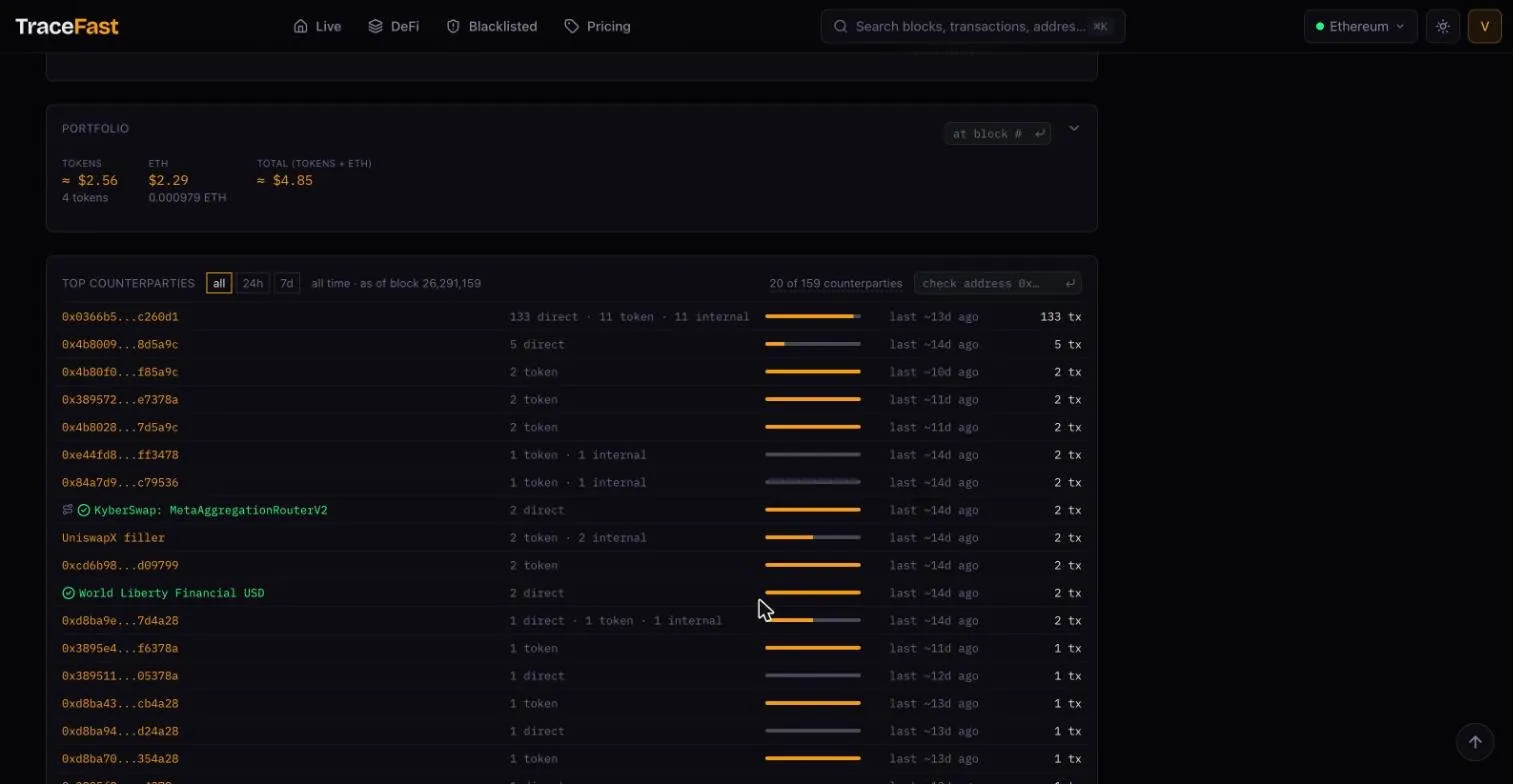
The gas wallet is the longer-lived anchor: active since late August 2026, 238 transactions, 2.39 ETH today.
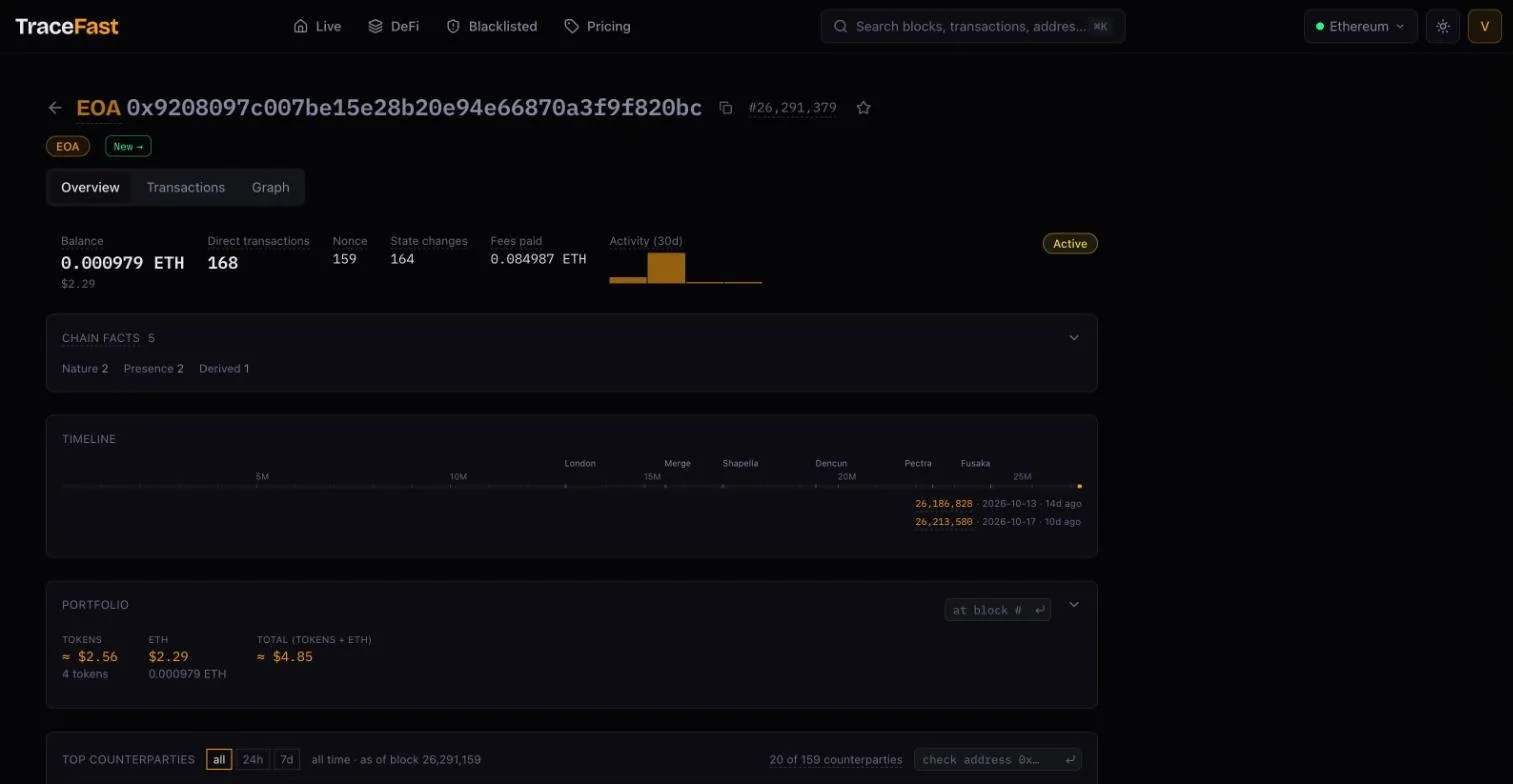
The operator address: born in block 26,186,828, 168 transactions, 0.000979 ETH left.
The wrong paste
At 23:52:59 UTC, block 26,186,979, nine minutes after the drain, 0x9208…820bc sent 9.576886711846137229 ETH to sven.eth. That was not a refund: it was the wallet’s entire balance. Up to that block the operator had received 0.05 ETH of gas, 9.1237 ETH from sven.eth and 0.434 ETH from sixteen other accounts; 9.5769 is that sum minus fees. Twelve blocks later the gas wallet had to fund it again with 0.02 ETH, because it stood at zero.
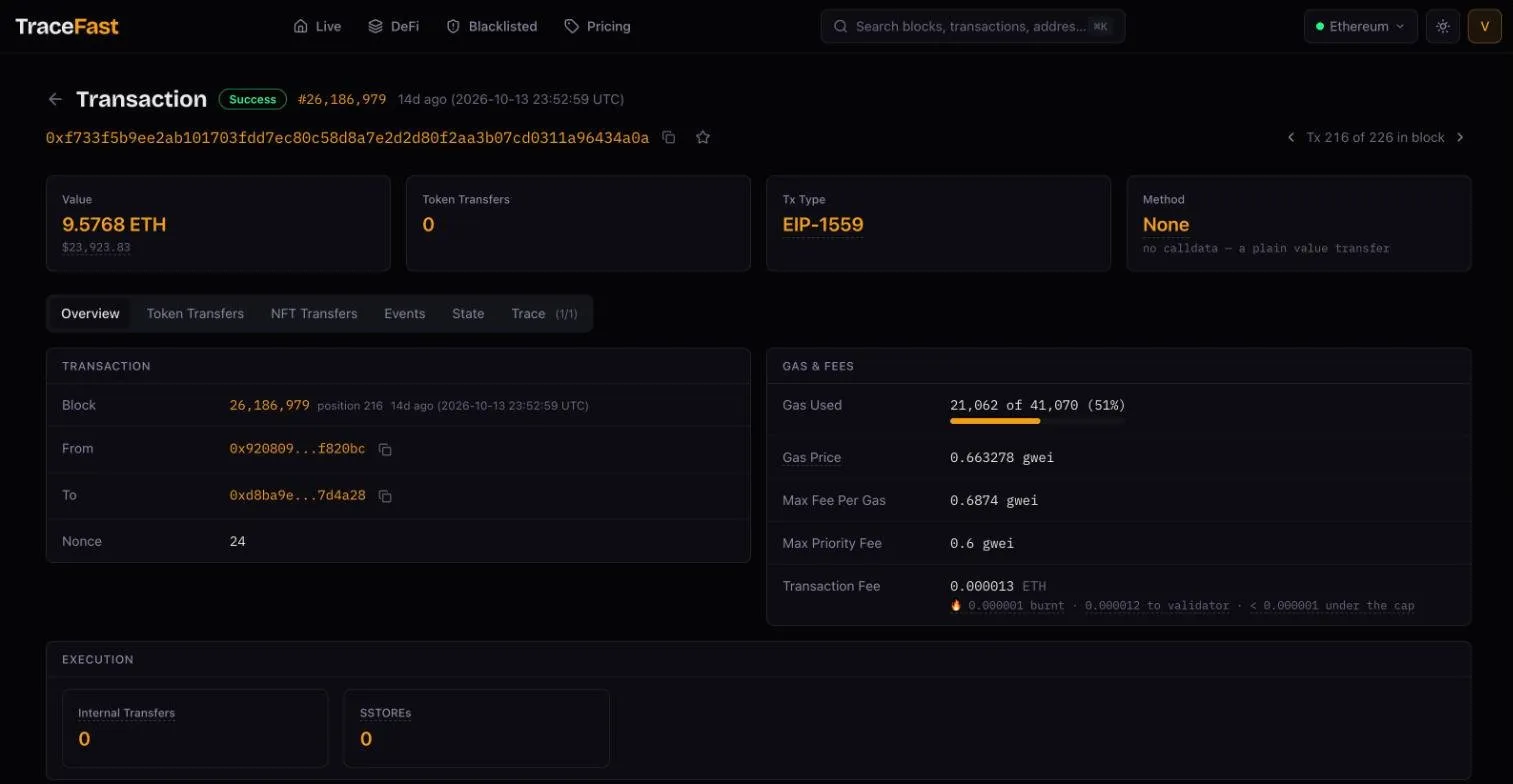
Block 26,186,979, 23:52:59 UTC: 9.5768 ETH, the operator’s whole balance, sent to sven.eth.
The simplest reading, first made by @sprunky_eth on October 14 (x.com/sprunky_eth/status/2110292178442305944): a consolidation error. The operator meant to move the take to its own address and pasted the last counterparty instead. sven.eth ended up holding sixteen strangers’ ETH on top of its own. The chain records the transfer; that thread records the explanation, and we should have found it before publishing.
sven.eth revoked the delegation at block 26,188,279 (October 14, about 04:13 UTC), 126 blocks after ExVul observed it still active.
The delegate contract is the pivot
A drain like this leaves three anchors. The attacker’s EOA is the weakest; this one lived eighteen hours. The strong anchors are the delegate contract and its bytecode.
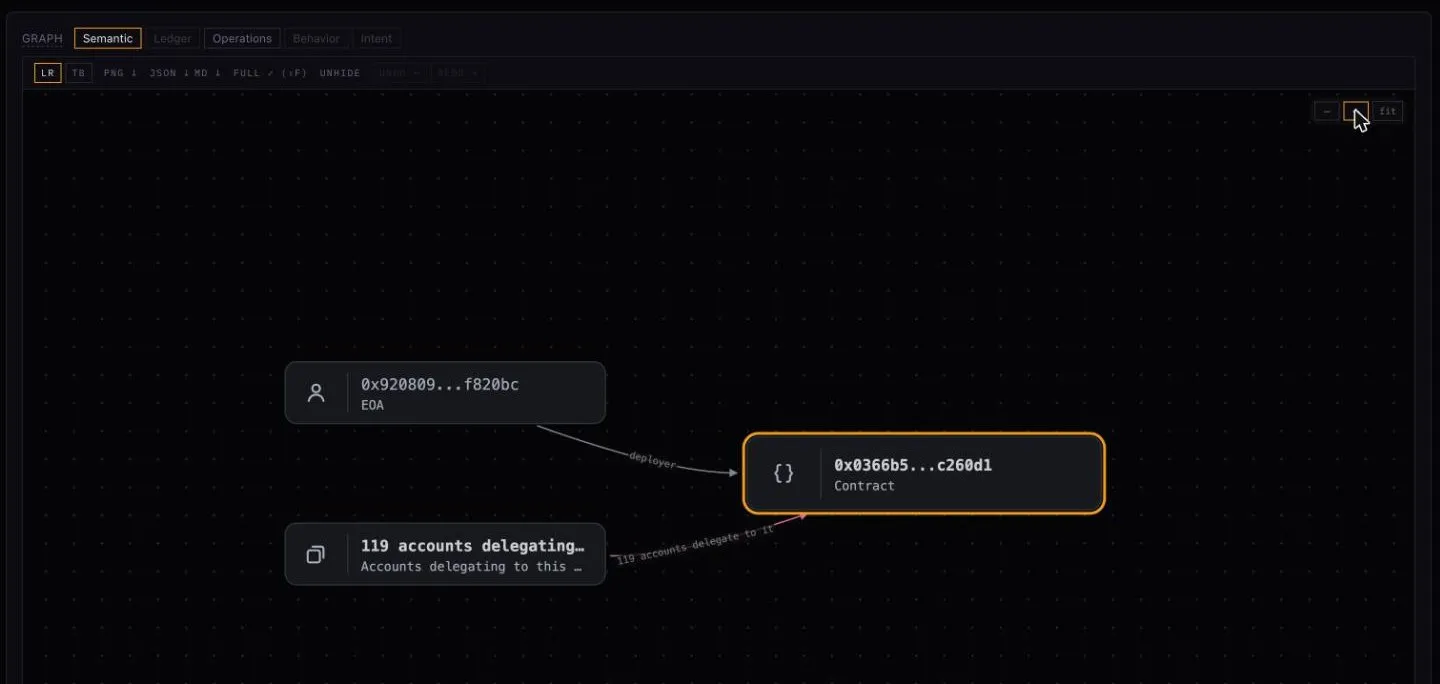
The contract’s graph: deployed by the operator, 119 accounts delegating to it as of October 28.
Every account wired to this drainer carries the same 23 bytes of code: 0xef0100 followed by 0x0366…260D1. That is a lookup, not a heuristic. As of block 26,291,006 (October 28), 119 accounts still delegate to this contract. sven.eth is not among them; the other 119 are. Any of them that receives ETH or tokens can be swept with one more sponsored transaction, for about $1.30 in gas.
The bytecode is the second anchor. This is not a CrimeEnjoyor-sized forwarder. It is 8.6 KB with 26 selectors: run(address,bytes); a second entry point the operator used to sell swept tokens through the contract (0xe2789c36); ERC-20 transfer, approve, transferFrom; WETH withdraw; and DEX hooks: unlock / unlockCallback as in Uniswap v4, pancakeV3SwapCallback, take(address,address,uint256), token0 / token1. A sweeper with a built-in sell path. No second copy of this bytecode exists on-chain yet; its code hash and structural fingerprint are what to search for when one appears under a new address.
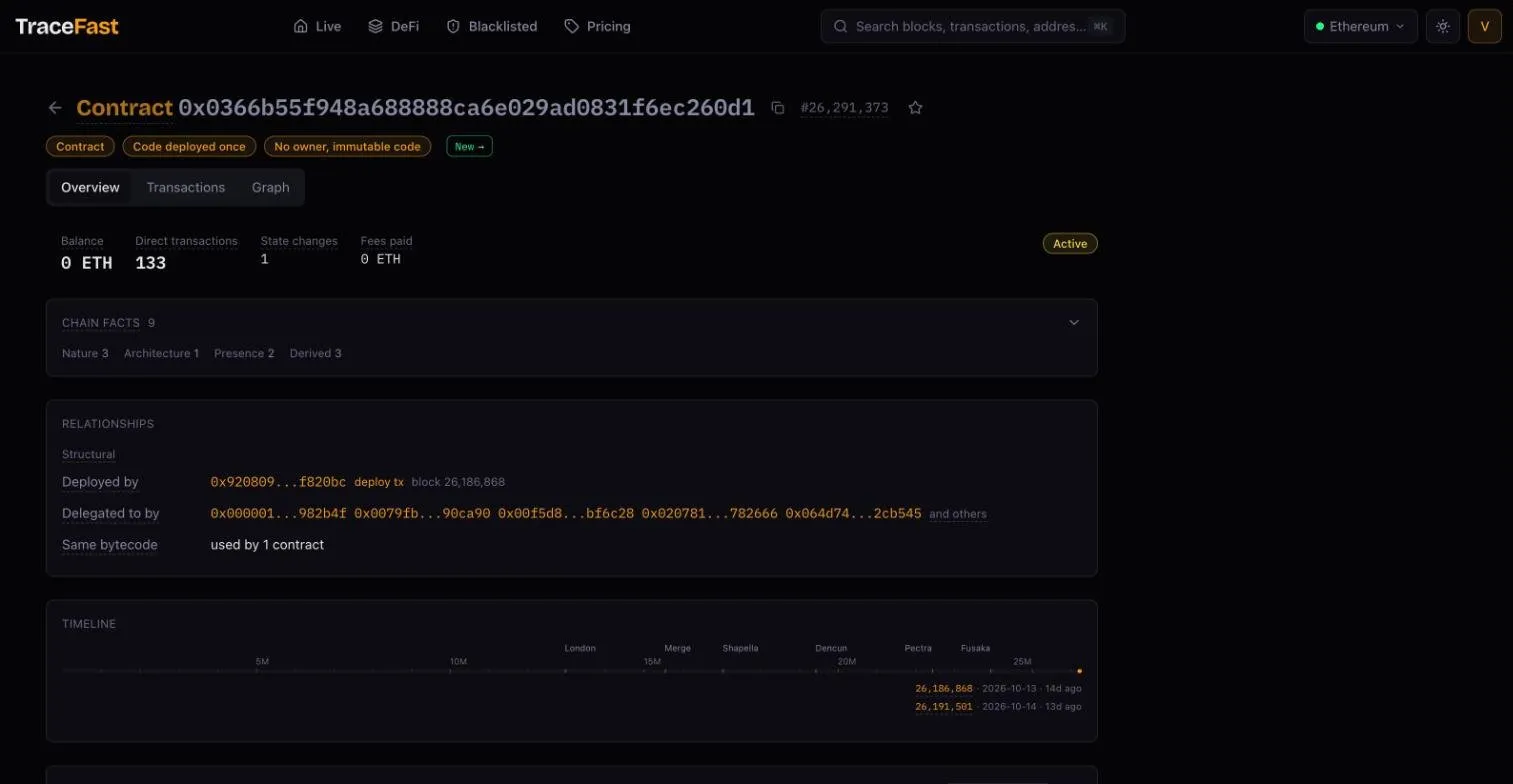
Deployed by 0x9208…820bc in block 26,186,868; 133 direct transactions; delegated to by 119 accounts.
The third anchor is money flow, above: a gas wallet that pre-dates the campaign, and an exit hop.
Footnote: the drainer got poisoned
Within days, address-poisoning bots found 0x9208. They emitted fake-token transfers from it to look-alike addresses: tokens named “ЕΤН”, a Cyrillic Е, a Greek Τ, a Cyrillic Н and invisible characters, in amounts copied from the real transfers (9.5769, 3.3188, 0.3268). They also sent 1-gwei dust from addresses imitating its real counterparties: 0xd8ba…4a28 for sven.eth, 0x4b80…5a9c for the gas wallet. Whoever runs the drainer now has a transaction history seeded with traps. Homoglyph tokens and fake-token transfers from look-alikes are the exact signals a poisoning detector flags on any address, including this one.
The operator’s counterparties: look-alikes of sven.eth (0xd8ba…4a28), the gas wallet (0x4b80…5a9c) and the exit address (0x3895…378a).
What to do with this
For a wallet, an exchange or a custodian: before you credit or interact with an EOA, read its code. 23 bytes starting with 0xef0100 is a delegation; resolve the delegate and check what it is. That check is trivial for one address and expensive at scale, which is where execution-level data earns its keep.
Everything above came from TraceFast’s API: the transaction trace and events, the contract’s lifecycle and selectors, the delegation relations, the entity’s transfers and counterparties. The same calls are open to any customer, and to any agent through the MCP server.
Addresses are given as on-chain identifiers; we make no claim about who controls them.
Transaction: tracefast.xyz/tx/0x36e0d1491c14e3d8e50bc70d73675b89d2d4712814d16f808f957c84fde820ee
Delegate contract: tracefast.xyz/entity/0x0366b55f948a688888ca6e029ad0831f6ec260d1
Operator address: tracefast.xyz/entity/0x9208097c007be15e28b20e94e66870a3f9f820bc
ExVul alert: x.com/exvulsec/status/2110227539696456075