A fake Safe, a fake Morpho and 114.1 ETH: the Aave v3 Loop Safe Module exploit, call by call
One transaction took 114.096 ETH from two Safes through an Aave v3 leverage-loop module: a fake Safe, a fake Morpho, and the trace, call by call.
On 1 October 2026 at 15:08:47 UTC, one transaction took 114.096 ETH out of two Safe wallets. Both had enabled the same module: a leverage-loop adapter for Aave v3. SlowMist flagged the incident and named the cause. We went through the transaction frame by frame on TraceFast, then repeated the whole investigation from scratch and reconciled the two passes. Below is what the chain shows, and what it does not.
One thing up front: nothing in this trace shows Aave, Morpho or Safe misbehaving. Every call into them is an ordinary one: repay, withdraw, flashLoan, execTransactionFromModule. The contract that accepted addresses chosen by its caller is the adapter.
The short version
- Loss: 114.096151469674448809 ETH, about $305.9k at that hour’s price of $2,680.996 per ETH.
- Victims: two Safes with one owner address and a threshold of 1. Both had one module enabled, the adapter 0x16bb…83d8, labelled FlashLoopAdapter on TraceFast.
- The attack: one transaction, 259 call frames, none reverted.
- The flaw in action: the adapter asked its caller whether the module was enabled. The caller was the attack contract. It answered yes.
- Aftermath: in the next 84 minutes three other addresses used the same path. One took the last 0.0101 weETH, one obtained ten unlimited approvals, one disabled the module on both Safes.
- Exit: 98 minutes after the exploit, 113.75 WETH went into contracts that TraceFast labels as RAILGUN.
- Offer: the Safes’ owner posted a 10% bounty on-chain, deadline 3 October 2026, 18:00 UTC. No reply as of block 26,106,060 (2 October, 17:14 UTC).
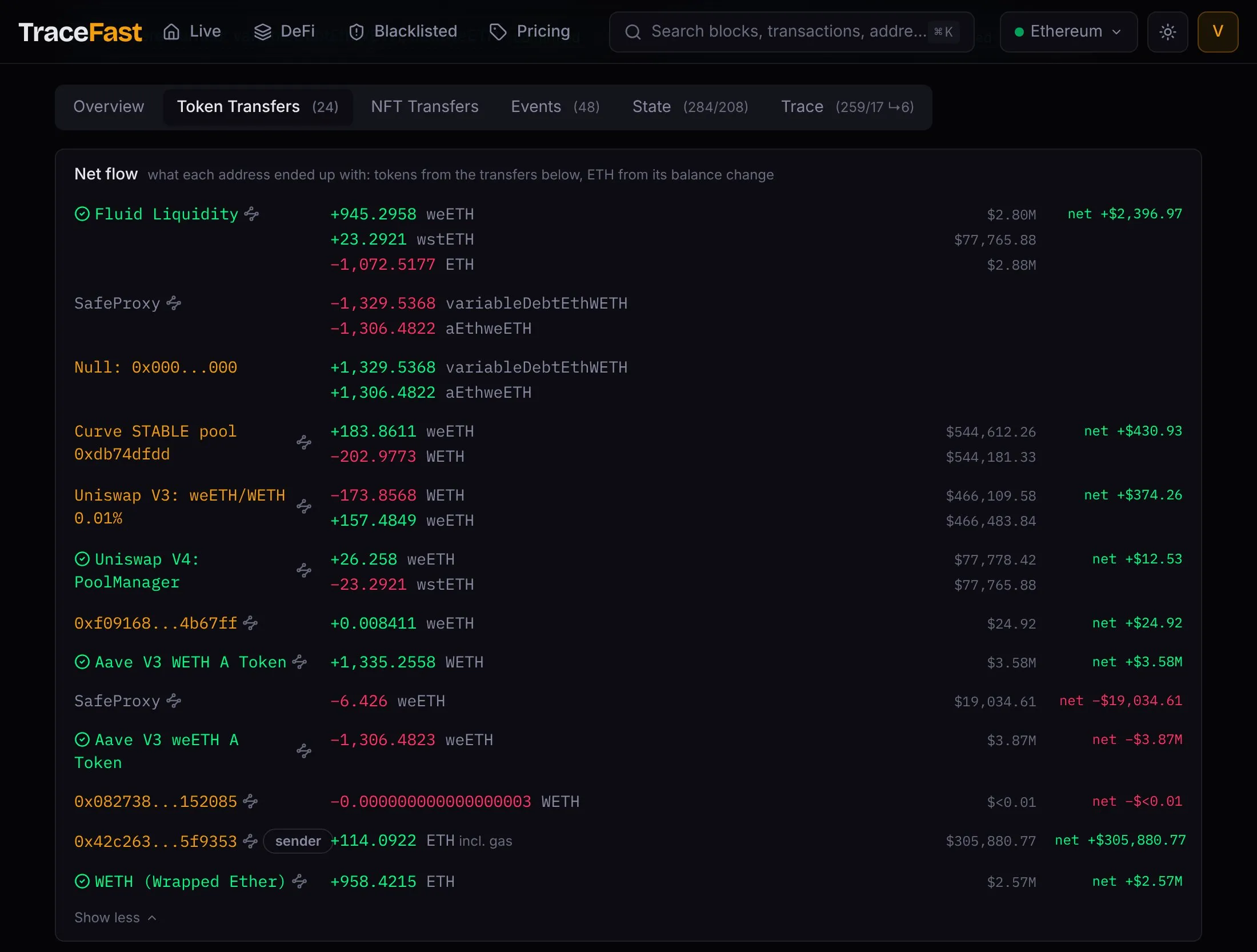
Net flow of the attack transaction on TraceFast: what every address ended up with. The sender is up 114.0922 ETH after gas. The two SafeProxy rows are the victims. 0.008411 weETH stays on the attack contract.
Two Safes and one module
- 16 July 2026, 18:52:47 UTC. 0x3cbd…6193 deploys the adapter.
- 17 July. 0x329c…3ed4 creates Safe 1 (0xe3b2…8520) and enables the adapter as a module. It then creates Safe 2 (0xcfed…169f) through a Safe 1 transaction and enables the adapter there too. TraceFast shows the ENS name aavechan.eth for this address.
- 18 July and 27 July. Safe 2 and Safe 1 use the adapter for the last time.
After that the module stayed enabled and unused for 66 days. When the attack came, Safe 2 held an Aave v3 position of 1,306.48 weETH in collateral against 1,335.26 WETH of variable debt. Safe 1 held 6.426 weETH in its wallet.
53 minutes of preparation
- 14:15:23. 0x42c2…9353 appears on chain for the first time. It receives 0.049875 ETH from Railgun Relay Adapt: 0.05 ETH minus the 0.25% fee.
- 14:44:23. It deploys a small factory contract.
- 14:56:11. It sends 0 ETH to itself.
- 15:02:47. The factory creates the attack contract, 0xf091…67ff.
- 15:08:47. The attack transaction.
The attack, call by call
- Borrow. The attack contract reads Morpho Blue’s WETH balance and flash-borrows all of it: 11,537.2397 WETH.
- Repay someone else’s debt. It repays Safe 2’s entire Aave debt, 1,335.2558 WETH, on Safe 2’s behalf. Aave lets anyone repay for anyone. With the debt gone, the collateral can be withdrawn in full.
- Call the adapter (selector 0xa10acfd6) with the attack contract’s own address in every address field.
- The check. The adapter asks its caller isModuleEnabled(adapter). The caller is the attack contract, and it returns true.
- The fake Morpho. The adapter calls flashLoan, not on Morpho but on the address it was given: the attack contract again. Amount: 0.
- The callback. The attack contract calls the adapter’s onMorphoFlashLoan. Inside it the adapter makes its “swap”: a call to a router with calldata, both supplied by the caller. The router is Safe 1. The calldata is execTransactionFromModule, transferring 6.426 weETH to the attack contract.
- The Safe obeys. Safe 1 sees a call from its enabled module and executes it.
- Again, for Safe 2. The same sequence runs with Safe 2 as the router. This time the payload is an Aave withdraw of 1,306.4823 weETH, sent straight to the attack contract.
- Sell. 1,312.9 weETH goes through Velora Augustus V6.2 in four routes and five swaps, for 1,449.352 WETH.
- Close. Repay Morpho, unwrap 114.096151 WETH, send the ETH to 0x42c2…9353.
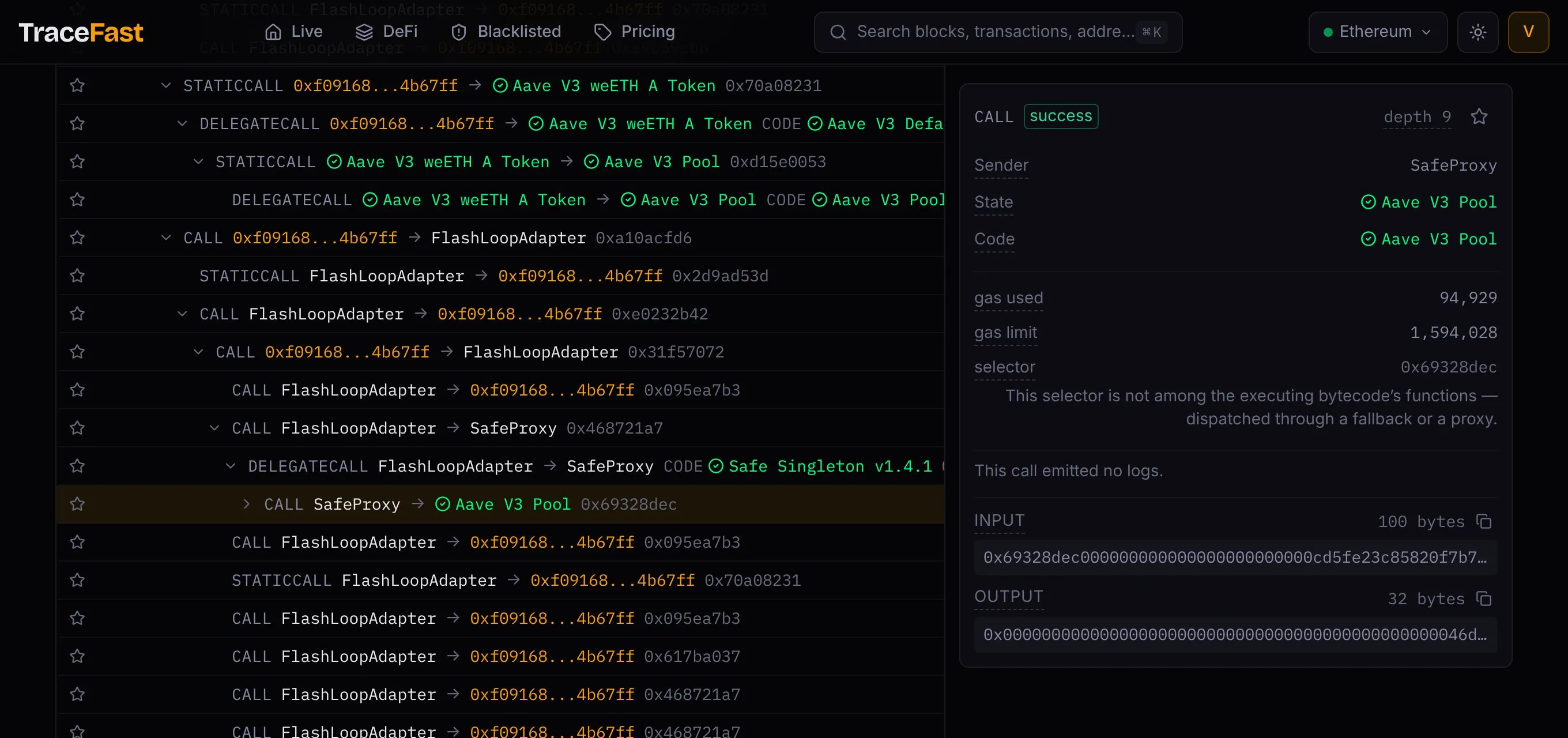
The pass against Safe 2 in the TraceFast call trace. 0xa10acfd6 enters the adapter. 0x2d9ad53d is isModuleEnabled, answered by the attack contract. 0xe0232b42 is flashLoan, called on the attack contract. 0x31f57072 is the callback. 0x468721a7 is execTransactionFromModule on the Safe. 0x69328dec is the Aave withdraw; its input ends with the attack contract’s address as the recipient.
SlowMist attributes the root cause to the adapter’s entry points checking only ISafe(msg.sender).isModuleEnabled(address(this)). The trace matches: that check is frames 28 and 58 of 259, and in both the address that answers is the attack contract. The trace adds a second substituted party, Morpho.
The arithmetic, to the wei
- Taken: 6.426087021311600894 weETH from Safe 1 and 1,306.482324969756972729 weETH from Safe 2, 1,312.908411991068573623 weETH in total.
- Sold: 1,312.9 weETH for 1,449.351954247184082179 WETH.
- Debt repaid for Safe 2: 1,335.255802777509633370 WETH.
- Left over: 114.096151469674448809 WETH, unwrapped and sent out.
- Never sold: 0.008411991068573623 weETH, still on the attack contract.
The four routes:
- 945.2959 weETH through Fluid weETH/ETH for 1,043.5323 ETH.
- 183.8611 weETH through Curve weETH/WETH for 202.9773 WETH.
- 157.4850 weETH through Uniswap v3 weETH/WETH 0.01% for 173.8569 WETH.
- 26.2580 weETH through Uniswap v4 into wstETH, then Fluid wstETH/ETH, for 28.9854 ETH.
At the realised rate, about 107.01 ETH of the loss came out of Safe 2’s position and 7.09 ETH out of Safe 1.
Three more callers in 84 minutes
- 15:27:11. 0xccc4…f855 runs the same path against Safe 2 and receives 0.010129688164171776 weETH, all the weETH Safe 2 still had.
- 15:44:47 and 15:49:23. 0xcccc…3447 makes both Safes approve it for an unlimited amount of five tokens: aEthweETH, weETH, WETH, wstETH and aEthwstETH. That is ten approvals in two transactions. Two more attempts, on the Aave debt token, reverted with OperationNotSupported(). The address then sent 54 one-wei transfers to itself and has not transacted since.
- 16:32:23. 0x3a06…6b3d makes both Safes call disableModule on the adapter. From this block the path is closed.
Five transactions went through the adapter that day. Together they left 19 module events on the two Safes, and every one of them is accounted for. We describe what these addresses did. We do not know who operates them or why.
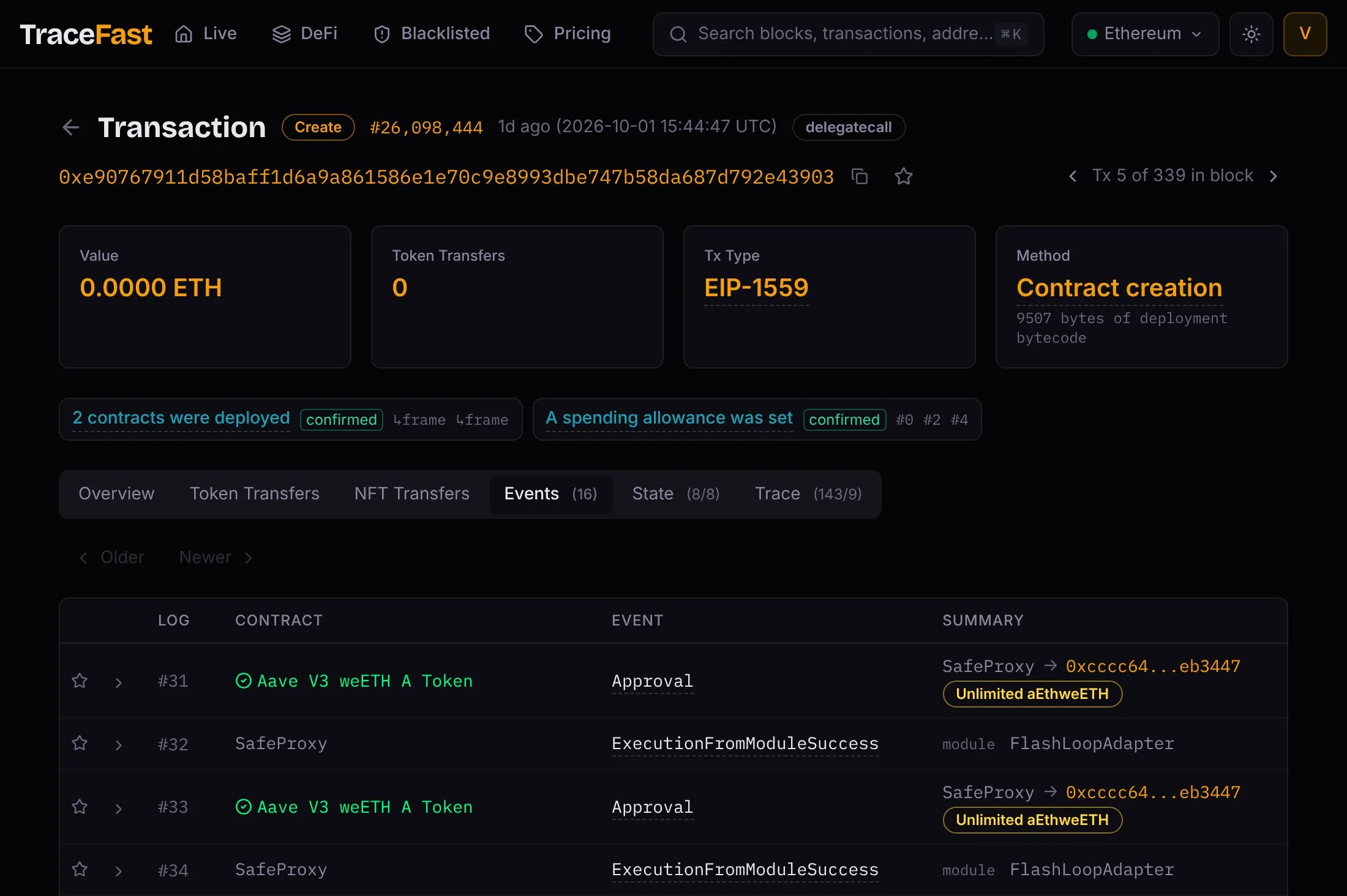
The first approval transaction: SafeProxy approves 0xcccc64…eb3447 for an unlimited amount, executed through the module. Rows 31 to 34 of 16 events.
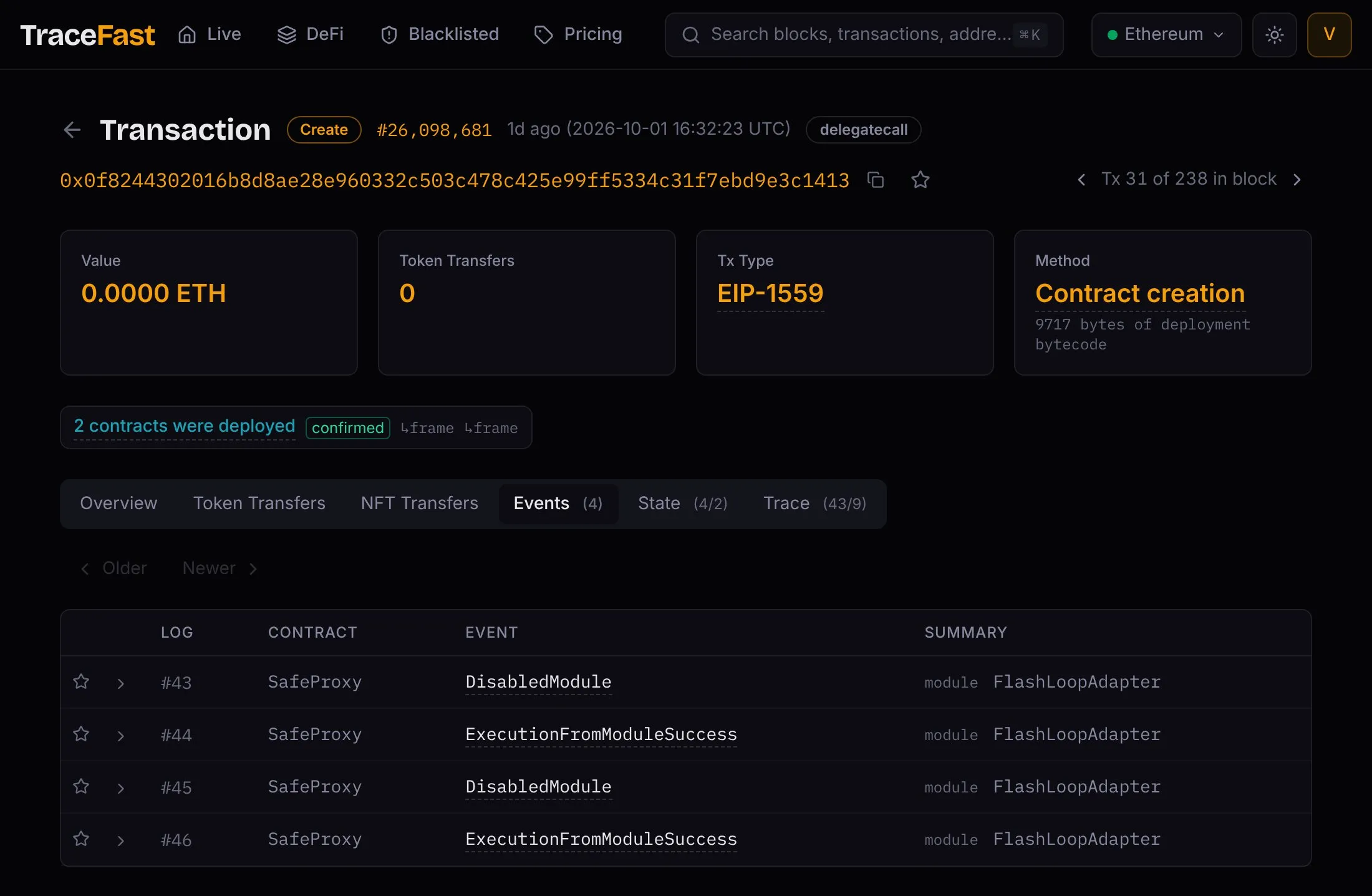
16:32:23 UTC: both Safes emit DisabledModule for the adapter.
Where the ETH went
- 16:45:59. 0x42c2…9353 sends 114.130726169100264326 ETH to a fresh address, 0x951a…2f1a, and keeps 0.01 ETH.
- 16:46:59. One minute later that address sends 114.0307 ETH to Railgun Relay Adapt: 113.745649 WETH goes in, 0.285077 WETH (0.25%) goes to the Railgun treasury. It keeps 0.0982 ETH.
“RAILGUN” here is the label TraceFast shows on these contracts. We did not try to match amounts and timing on RAILGUN exits. That would be a guess, not a finding.
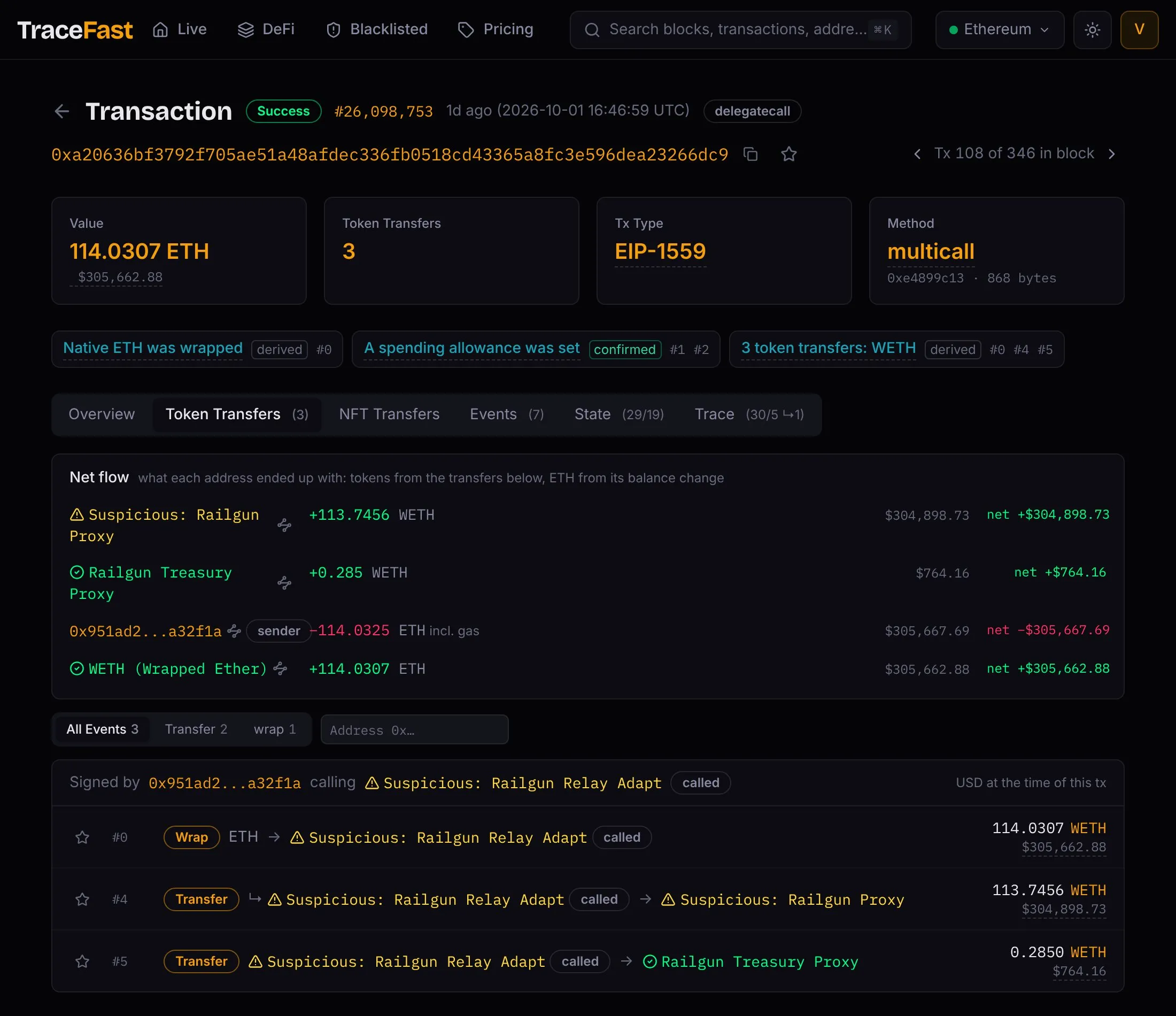
The deposit, 98 minutes after the exploit: 113.7456 WETH to Railgun Proxy, 0.285 WETH to the treasury.
Address poisoning, sixty seconds later
- 16:47:59. One minute after the deposit, the exploiter address receives 0.1 gwei from 0x951b…2f1a, a look-alike of 0x951a…2f1a.
- By 04:15 UTC on 2 October. Five dust transfers of ETH from three look-alike addresses, and nine Transfer events from fake “ETH” tokens for exactly 114.130726169100264326, the amount of the real transfer. Every event names the exploiter as sender; eight name a look-alike as recipient and one names the real address.
Four look-alike addresses in total, all starting with 0x951 and ending in f1a. This is the usual shape of address poisoning: a look-alike planted in the transaction history, next to the real one.
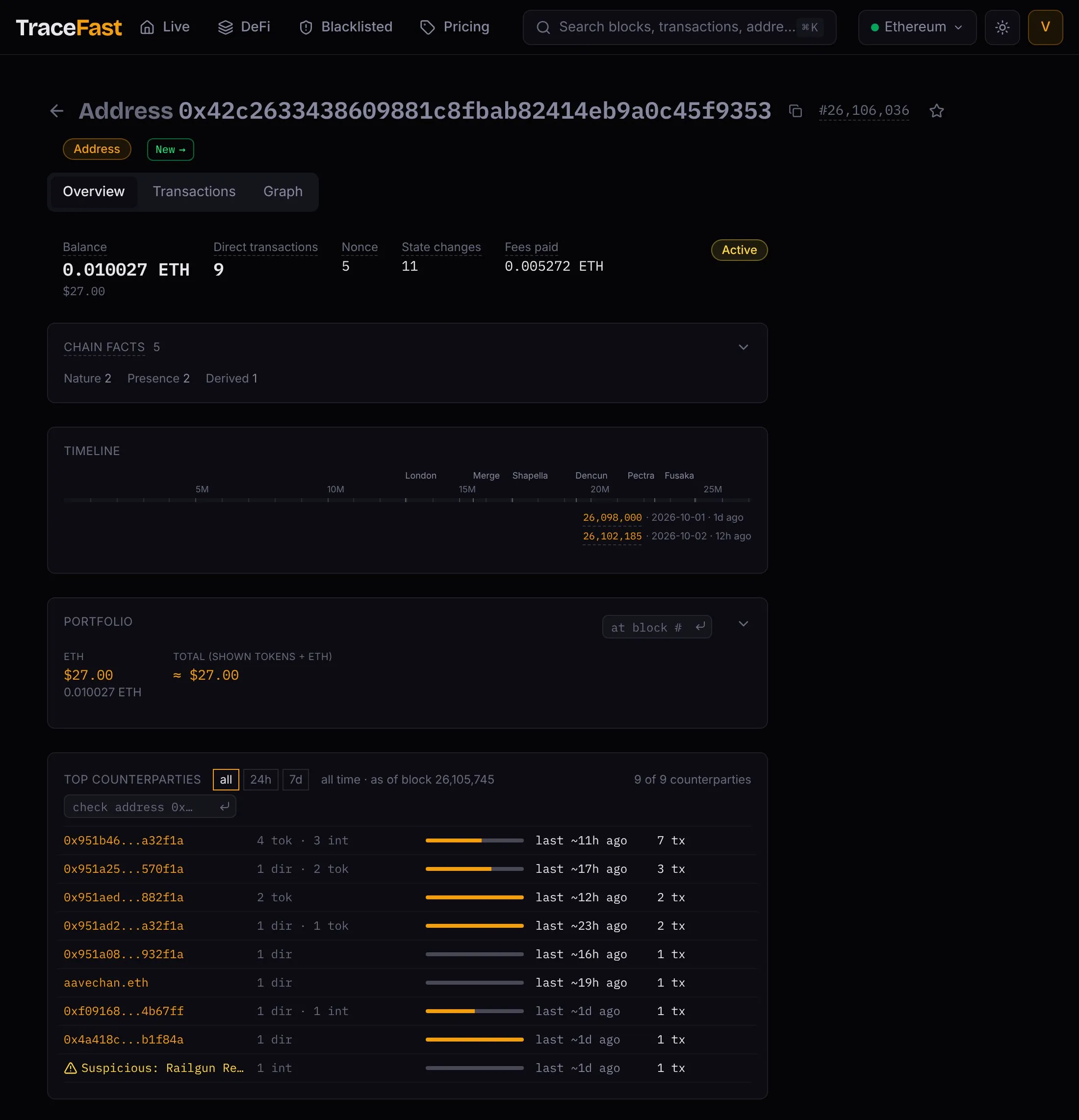
The exploiter address on TraceFast. Five of its nine counterparties begin with 0x951. Only 0x951ad2…a32f1a received the real transfer.
The owner’s message
At 21:03:23 UTC, 0x329c…3ed4 sent a zero-value transaction to the exploiter address with 531 bytes of text as calldata:
To the exploiter of tx 0x75328f916b1a0878724d364da5eb12b255160b894cb36c63ed5d718efc616fc4:
We are the owners of the two Safes drained in this transaction.
We are offering a 10% whitehat bounty. Keep 11.41 ETH and return 102.69 ETH to 0x329c54289Ff5D6B7b7daE13592C6B1EDA1543eD4 before 2026-10-03 18:00 UTC. If the funds come back in full by then, we will treat this as a whitehat rescue and close the matter.
After the deadline the offer ends and the case moves forward with the relevant parties.
Reply on-chain to this address.
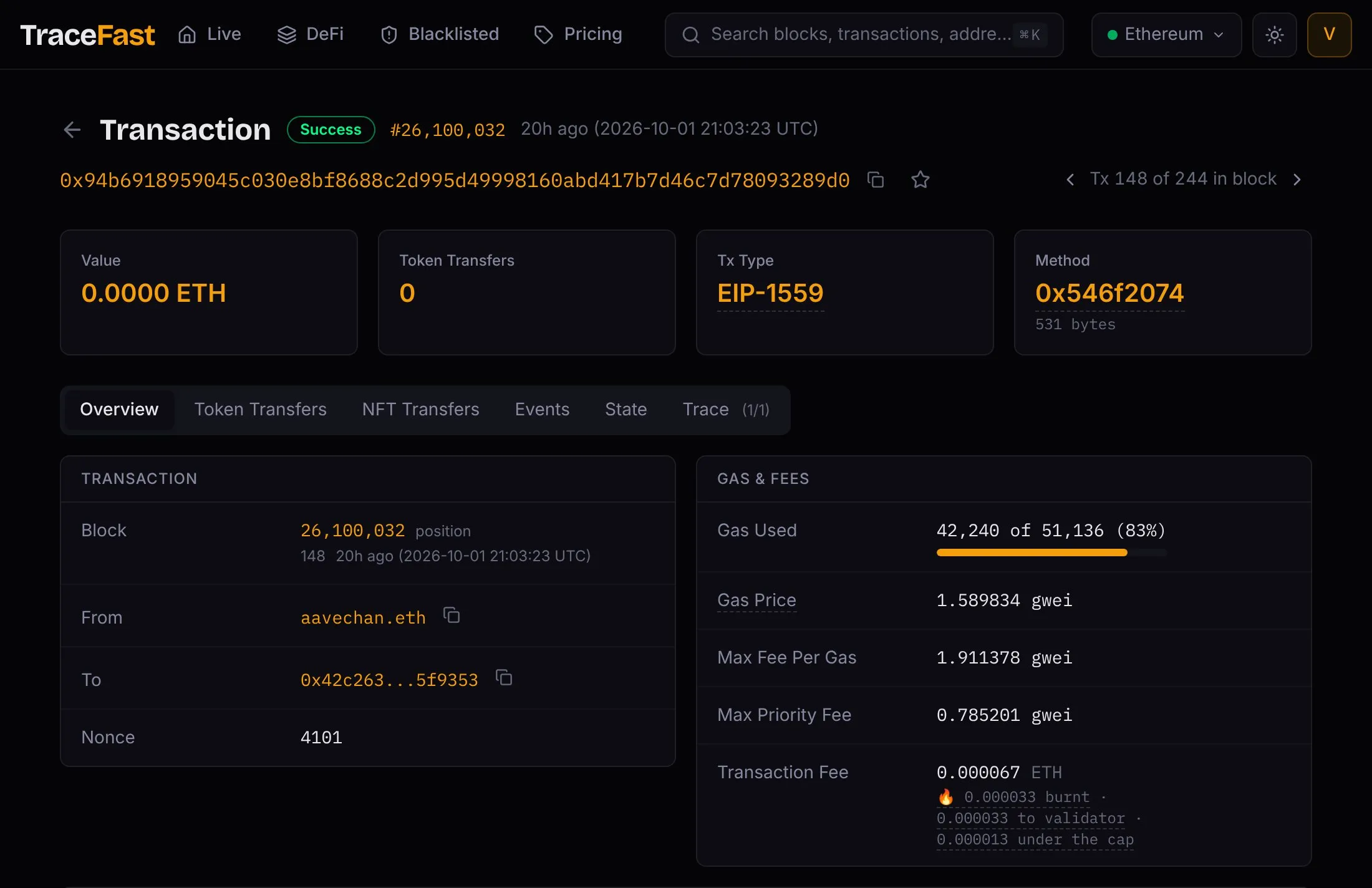
The message transaction: 0 ETH, 531 bytes of calldata, sent to the exploiter address.
Where things stand
As of block 26,106,060 (2 October 2026, 17:14 UTC):
- No reply. 0x42c2…9353 has sent nothing since 16:45:59 on 1 October. It holds 0.010028 ETH.
- The approvals stand. The ten approvals to 0xcccc…3447 show no sign of being revoked or used: neither Safe has emitted an event since the module was disabled, and no token has left either Safe since 15:27:11.
- Nothing left to pull. Both Safes are empty apart from dust.
- Still exposed. Until those approvals are revoked, any of the five tokens sent to either Safe can be taken by that address.
What we could not establish
- Whether other Safes have this adapter enabled. Its token flows have only ever involved these two.
- Whether the adapter checks who calls onMorphoFlashLoan. The trace shows a call from the attack contract going through. We have not seen the source code.
- Where the funds go after RAILGUN.
How we worked
Everything above is addresses, transactions, amounts and timestamps, read from traces, event logs and transfers on TraceFast. Names such as RAILGUN, FlashLoopAdapter and aavechan.eth are labels shown by TraceFast. We do not know who is behind any address and make no claim about it. The root cause is as described by SlowMist; the rest is our own reading of the chain.
Addresses and transactions
- Exploiter: 0x42c2633438609881c8fBAb82414eb9A0c45F9353
- Attack contract: 0xf09168963ac7b31917a02aa82fa9cd667f4b67ff
- Adapter: 0x16bb8b912da187870c23ec6756bb3fad061283d8
- Safe 1: 0xe3b23e47df7cd85876ac6cb05bdb9d7cd5b28520
- Safe 2: 0xcfedf95a3653a128dfc2e4288758a1a1850d169f
- Safe owner: 0x329c54289Ff5D6B7b7daE13592C6B1EDA1543eD4
- Received the ETH: 0x951ad21b85c1ce165f15d548a7c7d42520a32f1a
- Attack: 0x75328f916b1a0878724d364da5eb12b255160b894cb36c63ed5d718efc616fc4
- RAILGUN deposit: 0xa20636bf3792f705ae51a48afdec336fb0518cd43365a8fc3e596dea23266dc9
- Owner’s message: 0x94b6918959045c030e8bf8688c2d995d49998160abd417b7d46c7d78093289d0