How we build TraceFast
The principles TraceFast is built on, the layers of the platform, and what we are aiming for.
TraceFast is an Ethereum analytics and on-chain forensics platform. This article describes the principles we build on, the layers of the platform, and what we are aiming for.
Only facts
Our focus is the network’s own data. Every analytical statement on TraceFast is one of two things: a fact read from chain data, or a fact derived from such facts.
Names and labels are different. They are claims that somebody makes about an address. We keep them in a separate layer and mark the views that depend on them.
The same rule covers what we do not know. If data is not built yet, the API refuses the request. It does not answer with a zero or an empty list. An attribute we have not proven is simply not proven. It never means the opposite.
Our own archive node
Chain data comes from our own archive node. It gives us the full history and lets us read it down to execution: call frames, storage writes with the value before and after, and state as of a past block.
One example. A single Uniswap swap in block 26,386,200 is 28 call frames and 11 storage writes, each with its value before and after: https://tracefast.xyz/tx/0x02e8d25a2253380e75fcac3f9b1fa1d07c9c8f3f4e99a310d409c63198da776b
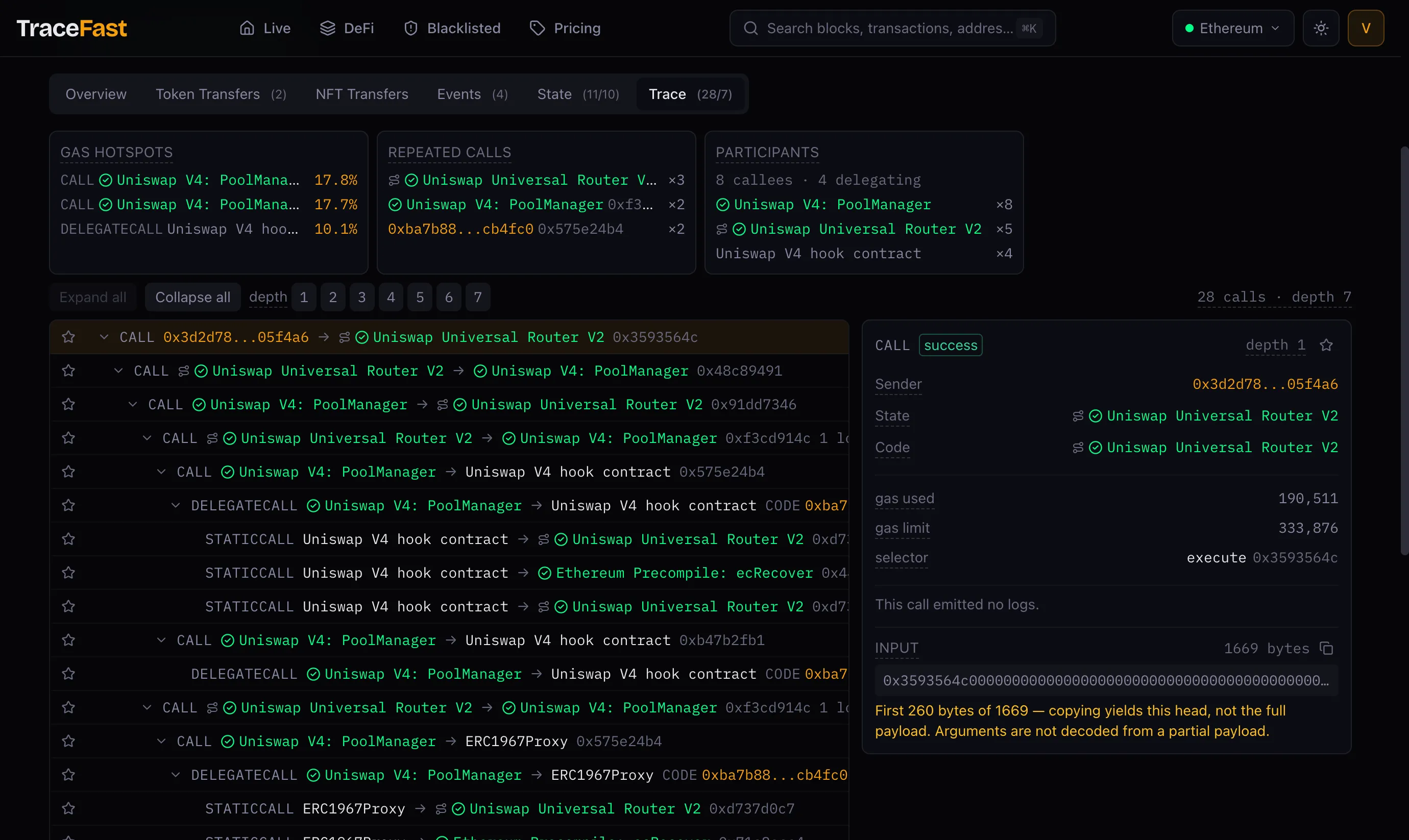
One Uniswap swap in block 26,386,200: 28 call frames and 11 storage writes.
A semantic layer of our own
On top of the raw data we maintain a detailed semantic layer, described in Apache Ossie (incubating), the open standard for semantic models formerly known as Open Semantic Interchange. It defines once what each dataset, metric and relationship means.
The layer itself is an internal product with no outside access. What it produces is public: the data you see in TraceFast is built with it, so every part of the platform reads the same definitions.
Atlas
Atlas is our attribute layer for addresses. It has two levels today:
- basic attributes, read from the chain
- derived attributes, computed from basic ones
A third level is in progress: behavior attributes, which describe how an address acts over time.
Atlas is recomputed continuously as the chain moves.
Every proven attribute has a proof: the facts that were checked, the expected and observed values, the conditions that had to be false, and the block and block hash the evaluation is pinned to. You can check a statement instead of trusting it.
Labels: claims, resolvers, entities
A label is a claim about an address, and it keeps its source. Resolvers turn claims into entities, using a detailed taxonomy. When sources disagree or the evidence is partial, that stays visible.
New labels come from two automatic flows:
- Discovery by rules. We keep an internal registry of ecosystems. Its owner labels the starting points of an ecosystem, and rules find the related addresses.
- Candidates from the platform. Analysis of Atlas attributes proposes addresses for labeling.
Both flows feed the labeling pipelines. A candidate is shown as a candidate, not as an established fact.
The registry is an internal product too, with no outside access. Its result is public: the names and labels you see in TraceFast.
Fraud patterns
The same pipelines work on fraud. Address poisoning is detected and labeled today: poisoning bots and the fake tokens that imitate real assets carry a danger mark.
Automatic detection of drainers and similar schemes is in progress.
What you can open
A transaction. Token transfers, internal ETH transfers, events, the full call trace, state changes down to storage slots, and contract deployments.
A block. Every address that took part in it, with its roles, not only the accounts whose state changed. And the dependencies between the block’s transactions, drawn as an interactive diagram.
An address. A graph on one canvas, in several projections: Ledger for value flows, Semantic for structure, Operations for decoded actions. A timeline shows the whole life of the address, and you decide where to open the next level.
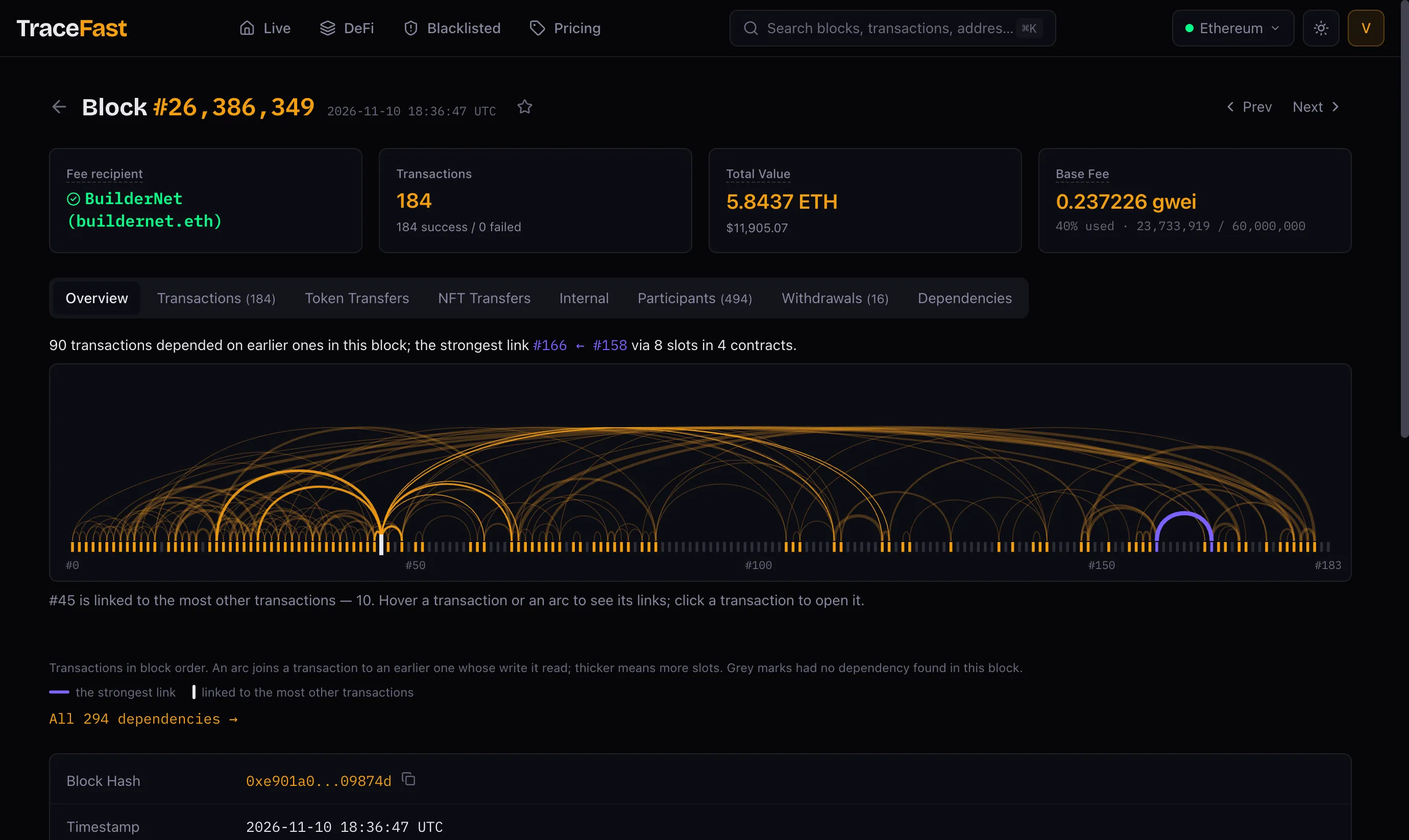
Block 26,386,349: 90 of its 184 transactions depended on earlier ones in the same block. 494 participants.
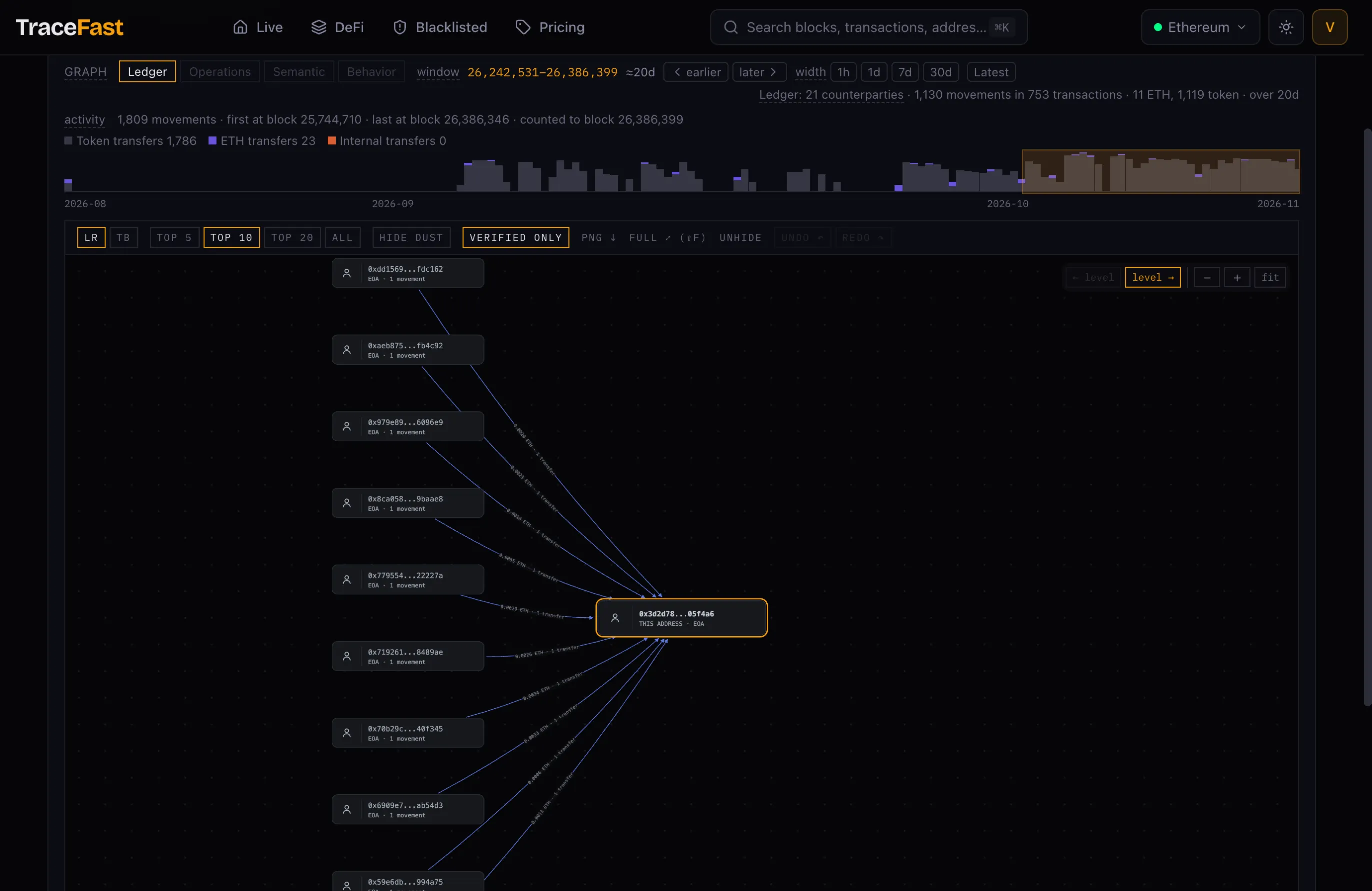
An address in the Ledger projection over a 20-day window: its top 10 counterparties, with the activity of its whole life on the axis above.
Live: dashboard and signals
The Live section follows the chain block by block: flows, tokens, DEX activity, storage, consensus, validator queues, gas and blobs.
Next to the dashboard there are now live signals of two kinds.
- Security: a role granted on a contract, an owner removed from a Safe, an account delegation set or removed, tokens pulled from many owners.
- Trader: liquidity drained from a pool, a token that refused a sell.
Every signal points to its transaction and block. Signals are on the web only for now.
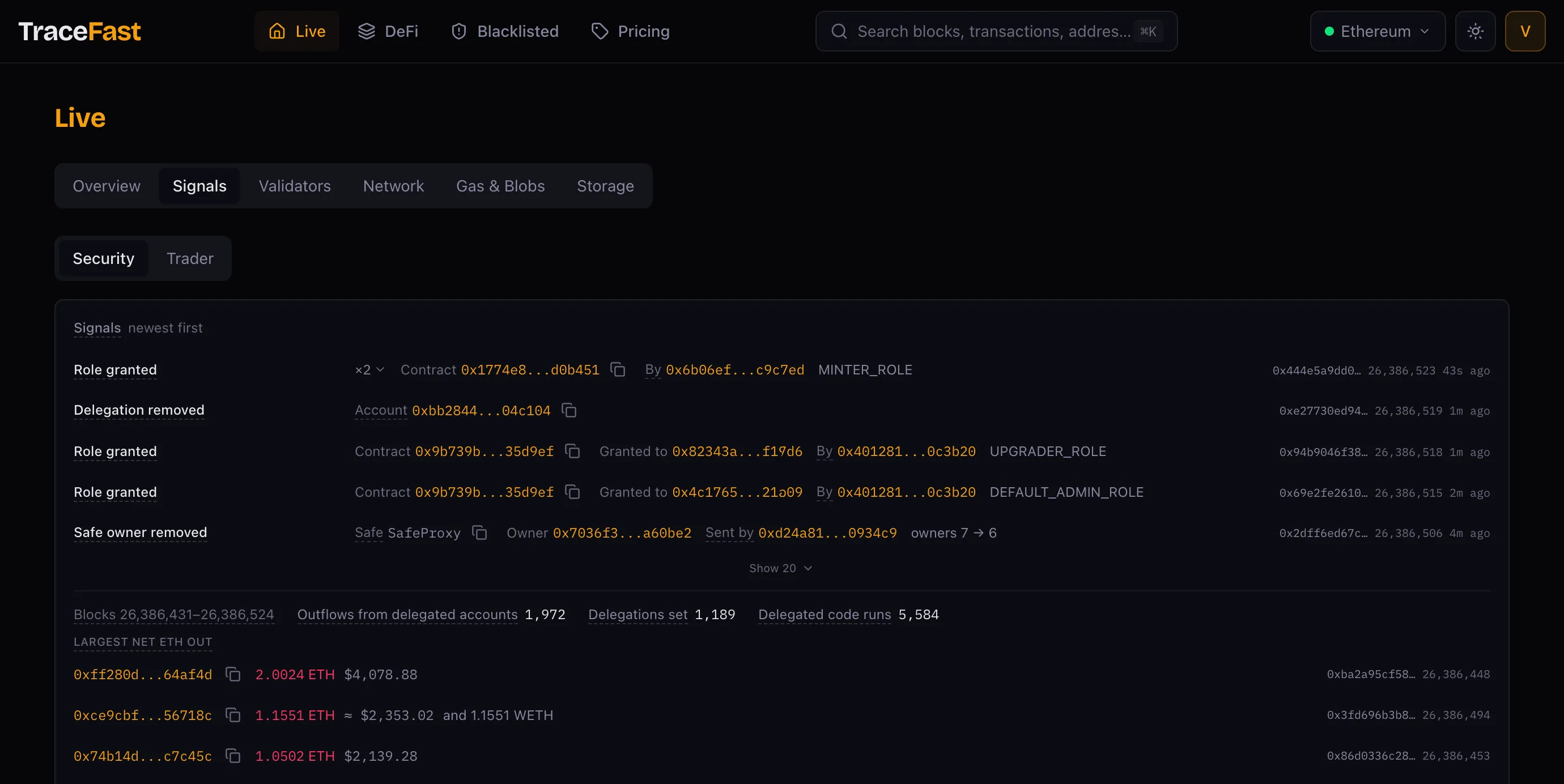
Live security signals: granted roles, a removed delegation, an owner removed from a Safe. Each row points to its transaction and block.
DeFi and blacklists
The DeFi section has four parts: DEX (pools, tokens, market share), flash loans, LP liquidity events with the largest removals and an outflow monitor, and curated protocol contracts.
A value shows how it was obtained. A pool’s TVL is marked verified or estimated.
The Blacklisted section shows freeze events and currently blacklisted addresses. It covers only token issuers whose identity is verified, and it says so on the page.
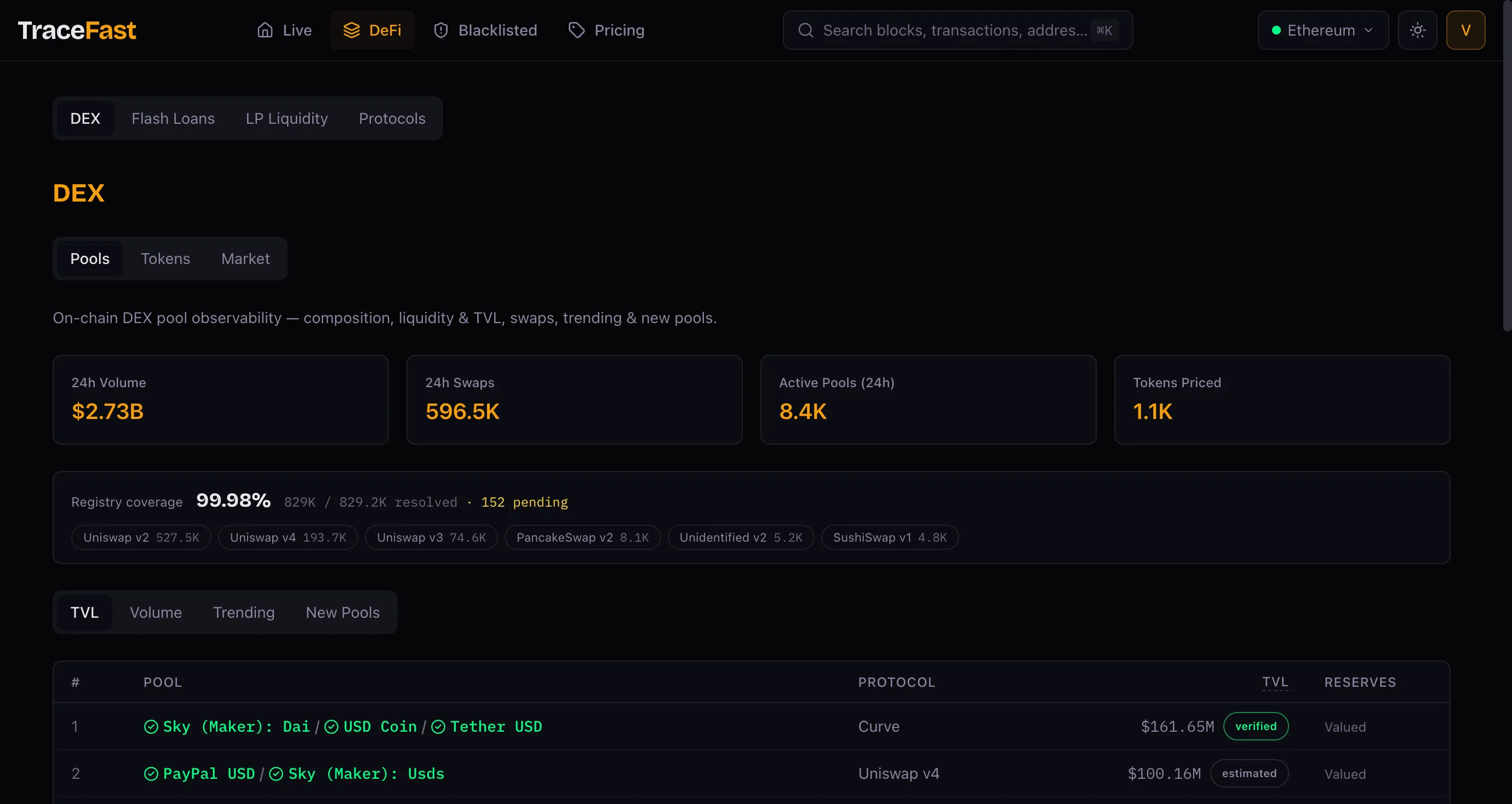
DEX pools: 24h volume, swaps, active pools and registry coverage. TVL is marked verified or estimated.
Favorites: your own notes on top
You can save addresses, contracts, tokens, transactions and blocks, and also single events and calls inside a transaction.
Each saved item can carry your own label, tags and a note. Only you see them. They never replace a name TraceFast shows and never change risk information.
Access
The explorer is free. Address names and risk flags are shown when you sign in.
API access is a subscription with three levels: Enriched Data, Intelligence and Investigation. The level sets which methods answer, your daily quota and your rate limits.
An MCP server for AI agents runs on top of the public API. Subscribers connect it with an API key or by signing in with OAuth, and the same subscription level applies.
Software agents can also pay per call over x402, with no account or key.
Where we are going
We want one place where security auditors, MEV researchers, compliance teams and investigators can trace every conclusion back to chain data.
Today we serve Ethereum mainnet.