Who actually took part in an Ethereum block?
Most addresses in an Ethereum block leave no mark on their own account. TraceFast now lists every provable participant of a block, with its roles.
“Who took part in block N?” sounds like a one-line query. The usual answer is the list of addresses whose own account changed: balance, nonce or code. Our block page used to answer that way too.
That answer misses most of the block. An ERC-20 balance lives in the token contract’s storage, not in the holder’s account. A contract reached by a STATICCALL changes nothing anywhere. A contract that only emits a log, or an address that appears only as an indexed event argument, leaves no mark on its own account.
TraceFast now lists every address a block touched in at least one provable way, with the roles it played. It works for every block since genesis and for the chain head, one block behind the tip.
The gap, in numbers
Three blocks, counted both ways:
- Block 26,050,000: 742 addresses with their own account changed, 3,420 real participants (4.6x)
- Block 26,060,000: 1,259 against 1,604
- Block 26,080,000: 295 against 672 (2.3x)
The ratio depends on what the block does. Airdrops are the extreme case: in one block near 26,050,000, 10,289 of 11,076 participants did nothing except receive tokens.
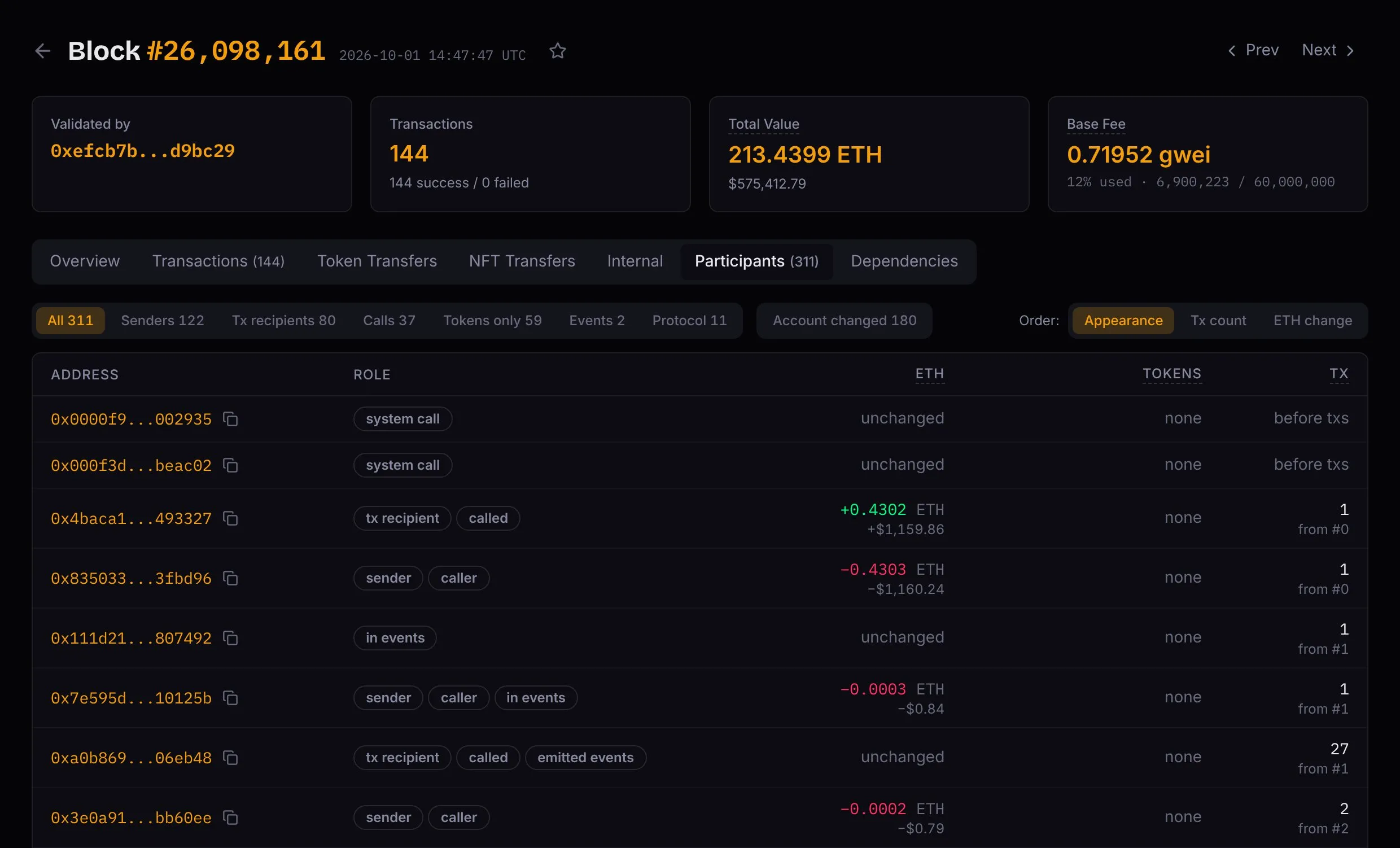
Block 26,098,161: 311 participants. Only 180 of them had their own account changed.
Fourteen roles, each one provable
One address can take part in a block in several ways. We show all of its roles at once, one row per address.
Transactions
- Transaction sender: the account that signed and started it.
- Transaction recipient. A contract creation has no recipient; the created contract appears instead.
Calls inside transactions
- Caller: any address that called another address, at any depth.
- Callee: any address that was called, including STATICCALL, DELEGATECALL and precompiles.
- Created contract: every contract deployed in the block, including those deployed by factories from inside other contracts.
Tokens
- Transfer party: sender and receiver of ERC-20, ERC-721, ERC-1155, ERC-777 and ERC-4626 transfers. Mints and burns put the zero address in this role. That is a fact of the block, so it stays.
Events
- Log emitter: the contract that emitted the log.
- Address in an event: an indexed argument, counted only when the event’s ABI declares that argument as an address.
Protocol
- Fee recipient: the address that receives the block’s fees (the miner before the Merge).
- Withdrawal recipient: the address credited by a beacon chain withdrawal.
- System contract: contracts the protocol calls by itself, outside any transaction. Beacon block roots (EIP-4788) in every block from 19,426,587. Block hash history (EIP-2935) and the validator withdrawal and consolidation request queues (EIP-7002, EIP-7251) in every block from Prague, 22,431,084. The system address the protocol makes these calls from is not a participant.
EIP-7702 delegation
- Delegation target: the contract whose code a wallet allows to run on its behalf.
- Authorization signer: the wallet that gave that permission. We recover it from the signature ourselves, and an invalid signature yields no signer. On average this adds about 3.6 addresses per block that are visible no other way.
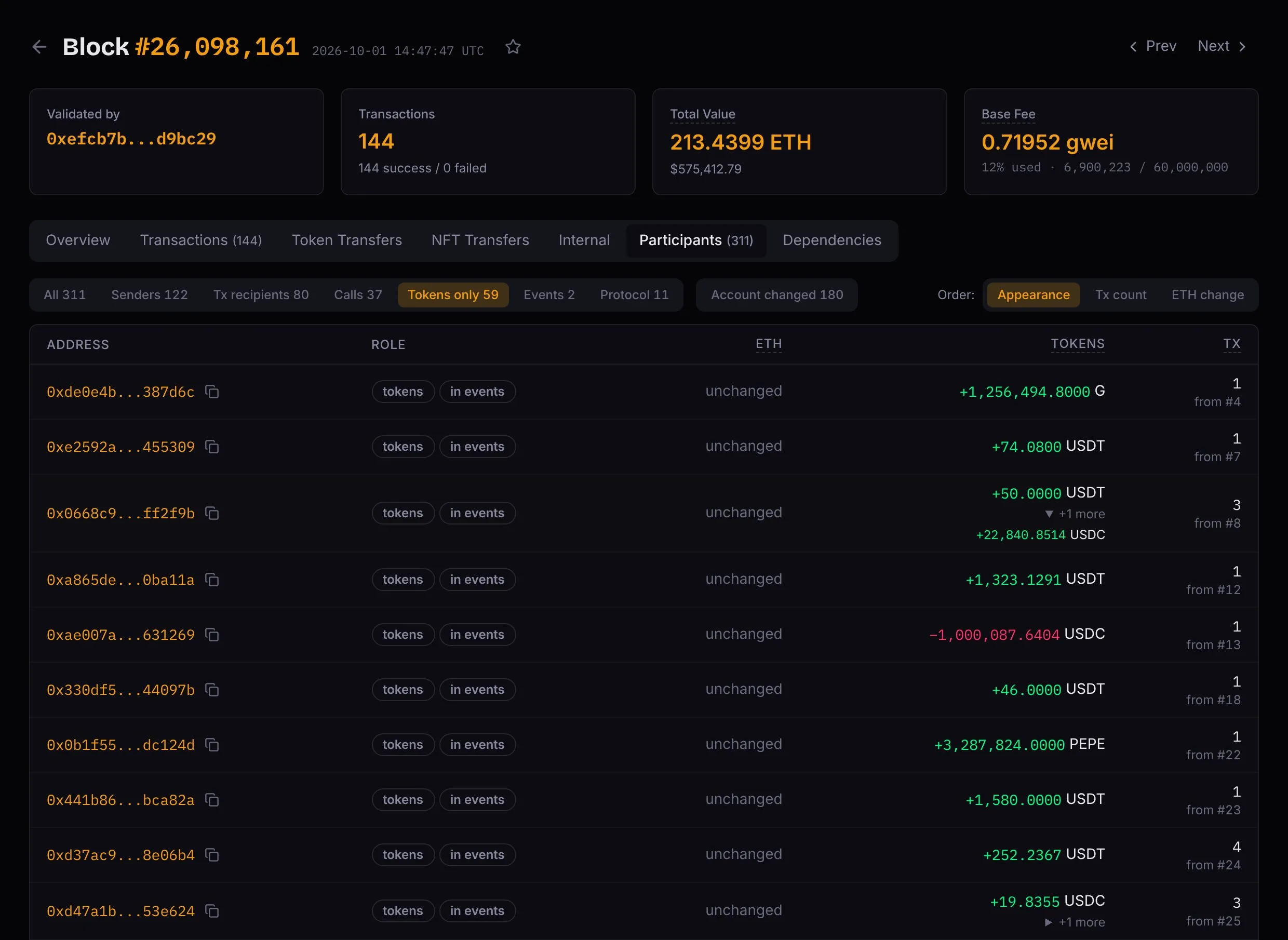
Transaction #40 of block 26,098,161: the sender, a token receiver, the EIP-7702 signer with seven roles, and its delegation target.
State
- Own account changed: balance, nonce or code. This also covers changes made outside transactions, such as block and uncle rewards.
What we refuse to count
A participant is a proven participant. The list contains no guesses.
- Addresses that appear only in calldata. Bytes that look like an address are a decoder’s guess, not participation.
- Addresses in non-indexed event data, for the same reason.
- Address-shaped values in indexed topics. Guessing by shape (12 leading zero bytes) pulls in NFT token IDs, packed values and the native-ETH sentinel 0xEeee…. In block 26,080,000, 7 of the 20 “addresses” found only in events were exactly that.
So an event address counts only when the event signature declares that argument as an address.
What you see for each participant
Primary class. Besides the full set of roles, every address gets one class: its strongest role. Classes do not overlap, so the per-class counters add up exactly to the total. The order is initiator (transaction sender or EIP-7702 signer), transaction recipient, call, token, event, protocol, state. On an airdrop block the token class folds all the pure receivers into one line.
Position in the block. Participants come in the order the block touched them. First the system calls the protocol makes before transactions (EIP-4788, EIP-2935). Then transactions, by the index of the first one where the address appears. Then what happens after transactions: beacon chain withdrawals, the end-of-block system calls (EIP-7002, EIP-7251), and the fee and reward recipients if no transaction touched them.
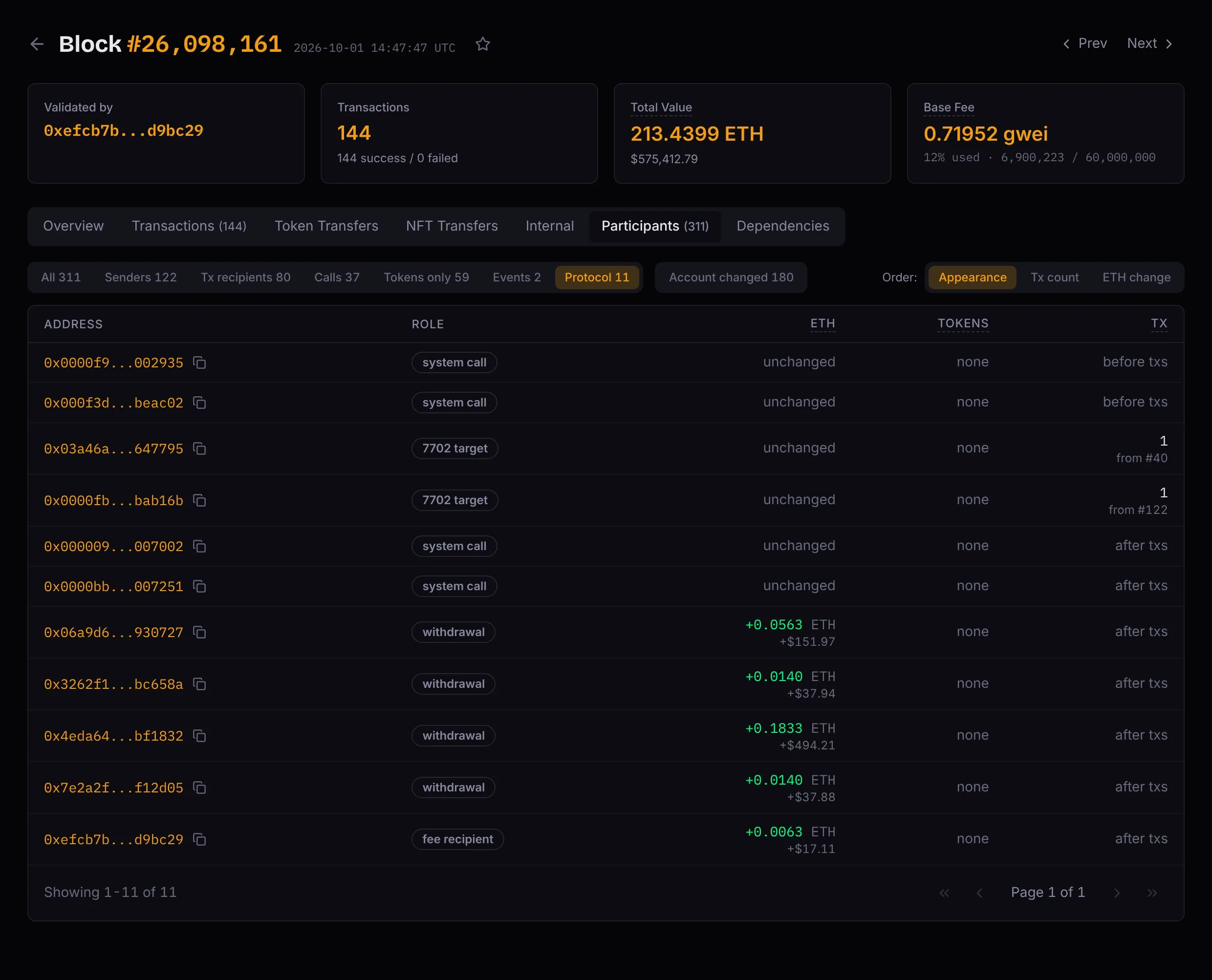
The protocol class in block order: EIP-2935 and EIP-4788 before transactions, EIP-7002 and EIP-7251 after them, then withdrawals and the fee recipient.
What the address was at that block, not today. EOA, contract, EOA with an EIP-7702 delegation, precompile, or an address that exists only inside contract storage. One page of block 26,080,000 shows 48 addresses: 29 contracts, 14 EOAs, 3 delegated EOAs, 1 precompile and 1 address with no type, because it appears only in events.
Token flows. For every participant and token: received, sent, net, the number of transfers each way, and the first transaction. Block 26,080,000 has 391 flows across 251 addresses and 51 tokens. In 76 of them the net is zero. That is transit: tokens passed through the address, as they do through a router.
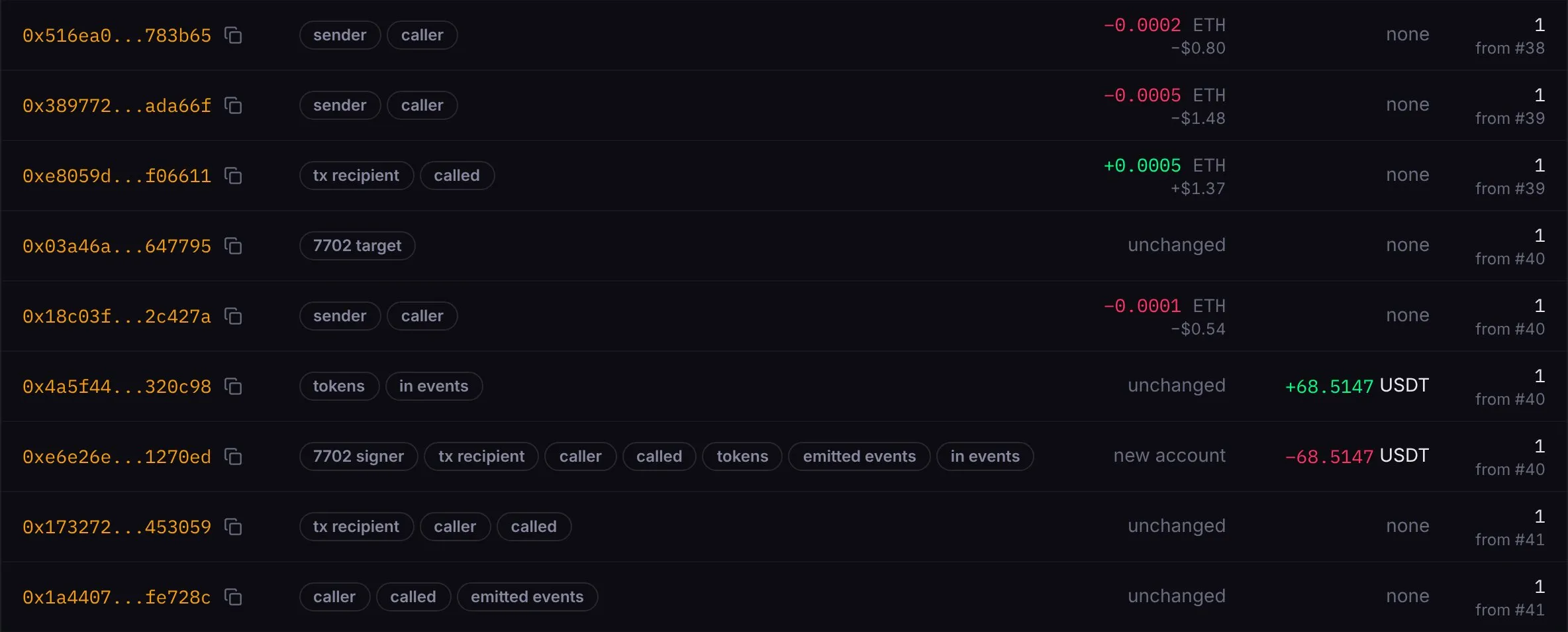
The token class of block 26,098,161: 59 addresses that only sent or received tokens, with the net flow per token.
Two details matter here.
- No double counting. ERC-777 tokens mirror every transfer with an ERC-20 Transfer event . ERC-4626 vaults repeat share mints and burns with Deposit and Withdraw events, denominated in the underlying asset . Both standards count toward the transfer party role, but the duplicates are not added to the flow totals.
- These are transfers, not balance changes. Rebasing tokens change balances without Transfer events, and those changes are not shown.
Verified, not promised
At the head. The current block appears one block behind the tip. One difference from historical data remains: a block at the very tip can still be reorged. Only the canonical chain is served, and reorged-out blocks never appear.
Empty does not mean nobody. Every computed block has at least a fee recipient. An empty answer means the block is not computed yet.
Checked every day. An automatic check runs blocks from every era of the chain and confirms that:
- every address from the old “own account changed” answer is in the new one, with that role;
- every transaction sender and recipient is in the list;
- every block has a fee recipient;
- protocol system calls start exactly at the fork blocks: 0 per block before Dencun, 1 after it, 4 after Prague.
Check it on a block you know
Pick a block you know well and open its participants on tracefast.xyz, or pull the same list through the API. If we missed an address, or listed one that should not be there, tell us: @tracefast_xyz.